Thursday, August 30, 2007

Continuation of the previous post.

I have two big weaknesses in my play: endgame and complex tactical positions.
With the aid of Hansens book I expect to make great progress with my endgame.
A far bigger problem though is calculating complex tactical positions.
For improvement in this area I need to improve my visualisation skills and my reasoning. Visualisation is in the backseat. Right now I focus on reasoning.

For reasoning I used depend on the trial and error method. According to this method I generate random nice looking candidate moves. The downside of this method is I generate way too much candidate moves.

Formulating narratives reduces the amount of lines to investigate drastically. This is an example of my previous post:

I have found:
  • g7 is the most vulnerable invasion square.
  • the queen is (can become) overworked since she has to defend g7 and e6
So the task to accomplish is to clear the long diagonal. In order to reach that we have to step up the pressure against e6, to remove the blockader of e5.
There are only two moves which accomplish this: 1.Rxe6 and Bh3

This way of reasoning drastically reduces the amount of candidate moves. If you look at the narratives of the whole position there are about 29 moves that remain to be investigated in total. It is quite due to the method of reasoning that it are only so few moves. The total time for reasoning was about 8 hours for this position. That is of course way too long. In a game you usually has 30 minutes time at maximum. That means that I have to learn to do it 16 times as fast. Of course that takes considerable exercise, but it doesn't look impossible. Besides that I have to work on my visualisation skills, since I must be able to see those 29 moves without problems, of course.

I'm very happy with the fact that I have discovered 3 tactical motifs that are the building blocks in a whole lot of positions.

A reaction to a comment from Loomis

In a previous post I contended that it is not good to start to think at the begin of a line, since that means trial and error. It is impossible to start at the end of the line, since that is not yet physical visible. Hence I consider it to be best to begin at the second motif and work your way back to the beginning. The second motife is often already partly visible. In yesterday's post I showed you how that works. I'm very happy with the discovery of invasion and overloading, since that is a common second motife in complex positions. Often being responsible for the complexity in the first place.

Loomis showed how difficult it can be to work backwords to the beginning. This is my first attempt to formulate a narrative to assist in this part of the job. The art is to formulate it in such way that it starts to look simple.


White to move and win.

Yesterday we found:
  • g7 is the most vulnerable invasion square.
  • the queen is (can become) overworked since she has to defend g7 and e6
So the task to accomplish is to clear the long diagonal. In order to reach that we have to step up the pressure against e6, to remove the blockader of e5.

There are only two moves which accomplish this: 1.Rxe6 and Bh3
Which one of them is best?

1.Rxe6 Qxe6 white has invested an exchange, so the attack must work
2.Bh3 this clears the pathway for e5-e6

Now what is the crucial question to ask here? In fact a stardard blundercheck:
Is there a counterattack that works?
Since a counterattack is always to prefer above defense. The counterattack
2. ...Qxa2
works. It attacks the bishop. The power of whites attack depends on this very bishop.

3.Rf2 Rf8 attacking the defense of the bishop immediately.
4.e6 Re7 now black is defended well. g7 is protected and e7 is prevented. Ofcourse white can win his exchange back, but at the cost of his strong bishop. Once whites second rook is traded it becomes evident that whites king is vulnerable too. Which equalizes the position.

Now let's have a look at the winning line. Why is it so winning?

1.Bh3 Bxh3 in stead of taking the semi-sacrifice black can try to reinforce e6. More about that later.
2.e6 Bxe6
3.Re6
an interesting diagram.


Black to move.

The material balance is restored.
The black queen can't take on e6 since she has to protect g7.
The rook hangs but cannot move because it must protect the knight.
h7 is pinned. The only chance for black lies in a counterattack.

3. . . . Nf8 now the black rook can escape if white saves his rook
4.Qf4! counter-counter attacking the black rook at b8 and defending g3.

To be honest, even the grandmaster didn't find this move and would have continued with 4.Rf6 Rxg3+ 5.Kh2 Rg7 6.Rd6 which wins easily too.

Now let's have a look at the last part where blacks decides to reinforce e6.
1.Bh3 Re8 The alternative 1. . . .Nf8 doesn't work: 2.Rxf8+ Rxf8 3.Bxe6+
2.Rxe6 Rxe6
3.Rf6 Rge7
4.Qg5 Qe8
5.Bxe6 Rxe6
I haven't been able to formulate a narrative for this line. Since there is no investment of matter involved the line seems to lead to a very good position without risk.

Now what can we make of all this? The most eyecatching fact is that for every defensive move you have to ask yourself is there a viable counterattack possible in stead of the straightforward defensive moves? So that adds up to 3 basical motifs where I have to look at in complex positions:
  • Invasion square
  • Overworked piece defending the invasion square
  • Counterattack
That should have prevented the mistake 1.Rxe6.
I guess that these 3 motifs cover an immense amount of complicated positions. Because it are this kind of motifs that are hard to see, hence they make the position complex.
I have looked at my latest problemset and this is what I found:

25% of the problems is busted by Rybka (!) indicating that even grandmasters are having trouble with complex tactical positions. Busted means in general that the position is drawish in stead of a win. Looking at the non-busted problems I found the following divison of tactical elements:

100% Invasion
56% Overloading
40% Counterattack
32% All 3 motifs

There is more to say, but I have to prepair for my choir now.

to be continued. . .

Wednesday, August 29, 2007

Another example of invasion and overloading.

Takchess asked the following question:

To speak to the invasion subject of last post. The invasion square is often at a crossroads where it interacts with multiple pieces. I wonder if there is value to mapping some of these fields of force. Ct-Art does this as part of their hint section. Do you think there would be any value in doing this?

Yes, I'm inclined to think that that would be very valuable. Let's investigate an example.


White to move and win.

It is miraculous how every problem in Polgars Middlegame book seems to revolve around invasion and overloading. I just took the next problem.

The first question I ask myself is where do my pieces converge?
  • Q+B: g7
  • Q+R+R: f8
  • R+R+pawn: f7
You see that I neglect at the moment that the long diagonal isn't cleared yet.
The next question is what are the defenders of these potential invasion squares?
  • g7: Q+K
  • f8: N+R+K
  • f7: B+R+Q+K
Especially important is the value of the defenders. The higher the value the worse the defense. Thus g7 has the least defense.

The next question is which piece is overloaded?
  • The queen has to protect e6 and g7
It's remarkable how often it is the queen that is overloaded.

Based on these data you can make a plan. First you have to decoy the blockader of e5 away since you have to clear the long diagonal in order to give the bishop access to g7. So the main line will be
1.Bh3 Bxh3
2.e6 Bxe6
3.Rxe6 Nf8
4.Qf4 attacking both Rb8 and Rg7 and black is lost.

There alot of other lines of course, but you get the idea. You see how the other tactical themes seem to revolve around the basic themes invasion and overloading. The decoy of the bishop, the clearance of the long diagonal, the discoverd attack e6 etc..

I stress again the importance of the value of the defenders of the invasion squares and the overloading of those defenders.

Tuesday, August 28, 2007

Levels of abstraction.

Warning: theoretical ranting ahead!


Before our house, along the water there used to stand about 20 pollard willows. Once every year the branches are truncated. The guys who do this have no idea what they are doing, so they cut all the life away. Even a strong tree like a willow cannot withstand such bad treatment forever. After 7 years 17 trees died. When I confronted the workmen with their incompetence, they were very surprised that there could be a relation between their treatment of the trees and the deceasing of the trees. They had never even thought of it. They thought it was an act of nature or something.

Just as stupid is my way of looking at a chessposition. I tend to see the position in my games as given facts, bearing no relation with my previous moves. Opportunities seem to materialize out of the blue.

When I tried to comment on Blue Devils comment on my latest post, a lot of new thoughts arose which I like to share. For your convenience I repeat his comment here:

Each time you explain it, it gets more useful and clear.

I have found that in my self-explanations of solutions there is a kind of optimal level of abstraction. I am getting to the point now where it sort of "clicks" when I am at the right level for a particular problem. Once I hit that optimal level it makes me more likely to remember the solution to that problem. Just memorizing moves is not enough: that is too concrete (even for mate in one, there are all sorts of features of the position to think about more generally: escape squares, the mating pattern used, etc).

It isn't that focusing on the solution isn't enough. Rather, a priori it is tricky to know the appropriate level of abstraction at which to explain the solution (or in your language, for the narrative). There is often a kind of cognitive "sweet spot", a level of abstraction that just feels right. But sometimes it takes a really long time to find it, like with this problem.

Plus, there probably isn't an objectively best level of generality. It depends how much you already know. E.g., I can use the concept of a 'trebuchet' as a basic explanatory device, but two years ago this would have made no sense.


I like to brainstorm about if it is a good idea to limit the study of a solution to a certain level of abstraction. If I take a look at the willow-killers, they saw trees each year as new. As something that had no relation with the trees of the previous year. Hence they couldn't see the relationship between their actions and the decease of the willows a year later. How weird it may sound, their surprise was genuine when I told them so.

It shows how sequential our consciousness work. We have difficulty to see things parallel. We tend to seperate the events in the tunnel of time. We see every situation as new. Take a look at a comic strip. The hero is present at 25 pictures at the same time. Yet we look at it as one hero going through the tunnel of time. We look at one picture at the time, forgetting the previous ones, seeing the next one as new.

If you step back, take some distance, zoom out, you get more overview. You start to see the relationships between topics. You see causes and consequenties. You will learn new things you didn't know before while being a prisoner of the sequential tunnel.

Scientific research showed that the amateur sees every chess position as new. His brainscans reveal that he uses a part of the brain that is suitable for solving new complex problems. He makes heavy use of his short term memory.

And that is exactly how I experience my own games. If I have a rook ending, it appears out of the blue. I don't relate that to my own actions before. If I take the position from Blue Devil of my last post, I look at it as new. Having quite forgotten that I studied a similar position for a week about 1.5 year ago.

In order to overcome this problem it looks logical to build a meaningfull framework of a chessgame. If you can give every position you work on a place in this framework, it will become easier to retrieve information from previous positions.

Generalisation of a solution of a problem is the way to go. When you formulate higher abstraction levels, you zoom out. Which lessens the amount of visible details, but it increases the overview and consistency of patterns. Every higher level of abstraction reveals new facts.
If I take the position of Blue Devil from yesterday, there are two new topics that I had to formulate:
  • When there are two pawns of opposite color on the board, at least one of them will fall.
  • The distance of the kings to the enemy pawn is all important.
These two facts are new to me. That makes it mentally demanding to generalise solutions. It takes a lot of effort to find these new facts. Once found, they are of a head-slapping triviality. Why hadn't I thought of this before?

It is hard to think of a reason why you should stop at a certain level of abstraction. Of course the more you zoom out, the more lack of detail there is. But I think that it is usefull to have a framework that covers the whole game. Since it helps you to give every chess experience a place. A framework should give you more cues to retrieve similar positions from memory.

Let me try in a crude way to formulate a branch of the total chesstree in relation to yesterdays problem.

Level 0. Win the game.
Level 1. There are two ways to win the game:
  • Go after the enemy king
  • Queen a pawn and go after the king.
Level 2. Queen a pawn. In order to queen a pawn you must:
  • Penetrate in the opponents position.
  • Conquer the blockader of your pawn.
  • Free the road to promotion.
Level 3. Techniques of penetration.
  • Walk with your king to the center.
  • Attack the blockading pawns from behind with your pieces.
  • Attack two weaknesses at the same time.
. . .

Level n-1.
  • When there are two blocked pawns of opposite color on the board, one of them is going to fall.
  • The king that is closest to the enemy pawn is paramount.
  • The method of conquering the pawn is based on zugzwang.
  • If you are going to lose your pawn anyway, the only way to a draw is when you step on the keysquare right after the opponent captures your pawn.
  • Take always the widest arc possible without losing tempos to the keysquare, to prevent the enemy king from winning a tempo by shouldering you away.
Level n. The concrete position.

Of course it will take time to formulate what there is between level 3 and level n-1. But I'm sure it will reveal new facts. I'm thinking of the following: Can the statement When there are two blocked pawns of opposite color on the board, one of them is going to fall be generalized to two pawns at the same file, no matter the distance? And how about the pawns being on adjacent files, or quite separate files?

The framework I describe above is the positive framework of the attacker. The defender has ofcourse a negative form of the framework. Prevent the attacker from removing the blockader etc..

If I try to give Blue Devil's position a place in the framework it would be something like:
This is an endgame position where the main goal is to queen a pawn. In order to do that, the attacker has to remove the blockading pawn. Since black is going to achieve that, white must blockade the road to promotion with his king by means of opposition, which is a special case of zugzwang.

The coming time I will experiment with building a framework and investigate its ability to connect seemingly different patterns in order to ease retrieval from memory.

Narrative of a higher cognitive level

I hate the term higher cognitive level since it invites to be vague. But right now I don't know a better term so I hope you will bear with it.

Blue Devil has been struggling with this position, lately:


White to move and draw.

I have investigated a similar position about 1.5 year ago here, here and here. Although I have studied the position for days, I made the same mistake initially as Blue Devil by thinking the position above is an easy win for white.

This is a very important point. How can it be that someone studies a simple position with only 4 pieces for about a week and still he doesn't recognize a similar position after 1.5 years? Alright, the position is slightly different, but that doesn't explain this phenomenon. Because if you don't know how to work around this, all your study efforts will be in vain.

The fact is, I never formulated a definite conclusion about the position. I have just investigated it. I never formulated a narrative on a higher level, I got stuck with lower level narratives. I never looked at it from a distance. It are the higher level narratives that connect different positions with the same motif in the brains.

Let me first try to formulate a higher level narrative for this position, in order to reduce the vagueness of the term.

In a position with two pawns and two kings, one of the pawns will fall. Always! No matter what. The reason for this is that one side can put the other in zugzwang. If white starts to run after the black pawn headlessly, he will lose. The reason for this is that the black king is closer to the white pawn than the white king is to the black pawn. Hence black can put white in zugzwang. At move 4 black is already attacking the white pawn, while white can defend it only just in time at move 5.

5.Kf7 Kh6 and white is in zugzwang and loses his pawn.

The fact that the black king is closer to the white pawn is more important than the fact that the white pawn is so far advanced.

So white is going to lose his pawn at all times!
Hence white must find another way to maintain the draw.


The only way to draw is to conquer the keysquare g4 right after the black king captures the white pawn. Since white needs 6 moves to get at g4 and black needs only 5 to capture the pawn, the only reason that white is in time is because he is to move first.

But white can't afford to lose a tempo along the way! So he must prevent that his king is shouldered away by the black king. That is why he has to take such weird route. If black tries to confuse matters by deviating from his ideal path, white can afford to deviate from his ideal path too. Since if black loses a tempo, white is allowed to lose one too.

Of course it are the tricky guys like Grigoriev who put whites king at such a place that there is an only move. If the white king was placed on a2 there would be 3 drawing moves:
1.Kb1, 1.Kb2 and 1.Kb3. But you can find the only move simply by taking the widest arc to g4 at all times.

Summary in order to generalize this narrative:
  • When there are two blocked pawns of opposite color on the board, one of them is going to fall.
  • The king that is closest to the enemy pawn is paramount.
  • The method of conquering the pawn is based on zugzwang.
  • If you are going to lose your pawn anyway, the only way to a draw is when you step on the keysquare right after the opponent captures your pawn.
  • Take always the widest arc possible without losing tempos to the keysquare, to prevent the enemy king from winning a tempo by shouldering you away.

I have tried to formulate the narrative in such way that it describes all positions with the same motif. Now let's wait 1.5 year to see if it works:)

To repeat the main idea of this post:
First you have to formulate the motif of the specific position.
Second you have to generalize the formulation of the motif to all kinds of similar positions.

Without this second step you will find it later to be impossible to recognize the same motif in a different position. Since if you look only at the solution of a specific position, only the low level geometrical patterns are stored and those are different in a similar position.
Focussing on the solution is not enough, you have to generalize the solution. If you do that well it should cut down the need for solving tons of problems. Since there are only very few motif. Say 15 in the middlegame and 15 in the endgame. The difficulty is to recognize them in all different disquises.

It are the higher level narratives that connect different positions with the same motife in the brains.

A question of Takchess with more answers than he might want:)

Takchess asked me the following:

Invasion. Is this basically your opponent can't effectively stop your attack? ie: bad defensive position.

At first I thought that the ultimate goal to strive for in the middlegame was piece activity. Later I found out that the ultimate goal of piece activity is invasion. The point of invasion is that it hampers the communication of the pieces of the opponent. It divides the board in parts. Every piece with a higher value than the invading piece is hindered by the invader. These pieces cannot move freely in their own territory. Hence there is trouble to defend.

How do you find the invasion square? The invasion square is where you can have the upper hand. Where your own pieces converge and where the defenders can be outnumbered, or chased/traded/decoyed away.

Why is invasion so often a motif in complex positions? Because most other motifs are usually simple to see. Common tactical basic motifs like a discovered attack or a knightfork etc. are easy to spot since they have clearly visible targets in the form of pieces. But an invasion is against a square. Whether there is a piece or pawn on the square or not. The motifs that are easy to spot you will not find in complicated positions. As the central motif, I mean. You will find them to be the central motif in simple positions.

What has overloading to do with it? The invasion square is hard to spot, but it needs defence from pieces. If a defending piece has another piece to defend too, besides the invasion square, it can easy become overworked while that is hard to spot.


Overworked

Friday, August 24, 2007

Exercising out loud


Configuring CCT.

A thoughtprocess like Checks-Captures-Threats (CCT) needs modification to suit your personal needs. Let me see what is usefull for me and what not.
There are two goals you can go after with CCT: blunderchecking and generation of candidate moves. I think that CCT suits blunderchecking very well.
But blunderchecking is not my main concern at this moment. Right now I'm interested in candidate move generation. To that end I need to dismantle CCT untill it suits my needs. It will beome something maybe that is far away from the initial CCT-idea's, but that doesn't bother. Since I'm used to blundercheck every move anyhow, I will dismiss anything in CCT that has to do solely with blunderchecking.

Only threats. . .
A check is a special instance of a threat. So I will use the word threat as a replacement for a check, in order to keep things simple. After all, I have to work with it. If you look at captures, there are two kind of captures. The first kind of capture is also a threat, the second kind of capture is solely a capture, without a threat.

and non-threatening captures.
So I recognize a threat, which can also be a check, or a capture, or nothing. So I'm only interested in check and captures so far it are threats.
And I recognize a capture that is not a threat.
Now I have a list of just 2 items, and I like my lists short, as you might know.

Cashing in.
If we are attacking and we make a capture that is not a threat, we are cashing in the combination. This cashing in might or might not give you enough compensation for the invested material.

Safety net.
An attack can only prolong as long as you can continue to pose threats. Usually is thought that you have to calculate an attack until quiescence. But there is another possibility: the safety net. There are different forms of a safety net. For instance eternal check. But another possibility is to cash in the combination. A safety net gives you the choice to continue the attack or to stop. Beforehand it is not necessary the calculate beyond the safety net.

Serial vs parallel.
When you look at a position where there are a lot of parallel basic tactical elements, all elements are geometrically present at the board. That makes them relatively easy to see.
But in a serial line only the the first element is physically visible. The next tactical elements are only visible in the minds eye. That is why calculating long lines is so hard.
I would like to begin at the end of the line and work my way back. But is that actually possible? The last tactical element of the combination is physically not yet present or only partly present at the board. This means that it is not possible to start at the end of the line. But if you start at the begin of the line, the process of finding a suitable candidate move is quite based on trial and error. Which is the amateur way of playing chess. Take for instance the following diagram:


White to move and win.

The first move is 1.Nb5.
But why should you even consider to give a knight away?

The first tactical element is clearly visible: a knightfork at c7.

The second basic tactical element is only visible for the trained eye: the invasion at square d7. As said, invasion and overloading are basic tactical elements that you find time and again. And they are hard to spot since often an empty square is involved. In this position there are 3 potential empty squares that might be made suitable for an invasion. You have to investigate all your possible attackers and all your opponent's possible defenders for these squares. Then you will find that the knight at f8 is overworked. It has to defend both invasion square d7 and the bishop. The exchange sacrifice at e6 will take away two defenders from d7.

This second tactical element forms the very reason for existance for the move 1.Nb5. which in itself threatens 2.Nc7, the first tactical motif. So it is possible to think backwards from the second tactical element to the first.

I can't stress enough the importance of the tactical elements invasion and overloading. They seem to play a role in at least 90% of the complex problems I have seen and they are hard to see because it is about empty squares, sometimes even with a pawn or piece on it, wat makes it not easier to see the underlying invasion.

If 1.Nb5 cxb5 2.Rxe6+ Kf7, you can cash in with Rd6 which is your safety net.

The main line continues 1.Nb5 cxb5 2.Rxe6+ Nxe6 3.Bxb5+ Kf7 4.Rd7+ and black is lost.

Wednesday, August 22, 2007

Clownhole in one


And a few pictures which I didn't use, especially for David and Eric:)


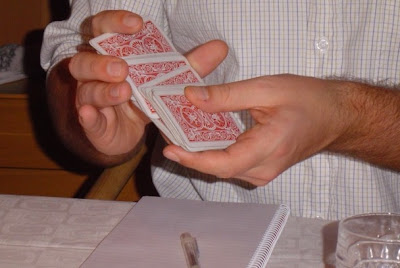
How to shuffle cards


(looks like cheating to me)

Once I explained my mother how to shuffle cards. I told her that a supple wrist was absolutely essential. We hadn't a deck at hand, so I could not show her. When I came home and took a deck of cards and shuffled them, I noticed that my wrists were stiff during shuffling. In fact it was virtually impossible to shuffle the cards with lose wrists.

On the internet there is no lack of good advice about chess. But even if somebody is a renowed chessplayer, that doesn't mean that his advice is good. Because what happened to me, can happen to the mere mortal side of any master. It is absolute necessary that the advisor has put his advice into practice and has used the feedback for finetuning his idea's.

When you want to improve at chess you have to be very carefull with your use of time. Since there is more good advice around than you can ever follow within a lifetime. And most of it is not put to the test.

Take for instance the famous tree of analysis from Kotov. It is impossible to follow the advice from Kotov in practice. Nunn critisizes this, but his own proposal can't stand the test either.

After studying according to the tree of analysis during a few weeks, a hierarchy in branches starts to unfold. The basis is the risk that is involved. If you sac a knight, the line must work. So what happens when the opponent doesn't take the knight is the last line to investigate. Further the mind doesn't treat serial lines and parallel lines the same. For that reason I consider it to be best to handle the long serial lines first. Then you work your way backwards to the beginning. I hope to formulate a more definite tree-handling-system within a few weeks. The fact that these obvious points aren't mentioned, signals that the authors have devised their idea's theoretically, but that they haven't put them to the test.

The same is true for the famous CCT-system. Checks, Captures and Threats. If you apply this in practice in a complex situation you will find that your list with candidate moves is way too long. A lot of the candidates are simply not worth to investigate. In general it works better from the end backwords in stead of starting with the candidate moves.

I must express myself precise. I don't say that the idea's of the tree of analysis and the CCT system are wrong, I say that they are not worked out in practice. Which means you have to invest a few months yourself to make these theoretical idea's usefull in practice.

And even that is not bad, but of course you always hope that someone has done the dirty work for you.

Sunday, August 19, 2007

How usefull is opening study?

Both Takchess and HisBestFriend raised a question about the usefullness of opening study.
I'm not a grandmaster, so my verdict has not the power of law. Yet if I look at the figures, I'm inclined to think are they insane? If I see grandmasters memorizing lines 20 moves deep or more, I get the feeling they are fooling themselves and each other. Isn't it just a matter of fashion? Let's try to use some reason.

Fischer suggested that openingstudy would kill chess in the end. In order to prevent that, and to become independant from the study of openings, he invented his shuffle-chess. Since Fischer chess has 960 different start positions, the amount of openingstheory becomes 960 x so vast. That raises the following question: can we create the same effect without altering the rules?
At every ply in the opening there are about 20 possible moves. If 5 of them are mainstream theory and 15 "unorthodox", you need only 3 plies where you make an unorthodox move. That gives you 15 x 15 x 15 = 3375 new possibilities. Are all these possibilities automatically bad since they are not part of the "theory"? That is hard to believe.

Have a look at the following table from my database with 650,000 mastergames.
It lists the moves that are played by white after 1.e4 c5 2.Nf3 d6

Move 3

white


#Games

Frequency


Score


Rybka
1: d43460381.6%53.5%+0.19
2: Bb5+449010.5%50.7%+0.17
3: c315923.7%50.9%+0.03
4: Nc37921.8%52.9%+0.21
5: Bc45111.2%56.2%+0.23
6: g31700.4%52.0%+0.03
7: d31250.2%37.2%+0.06
8: b3370.0%41.8%+0.05
9: Be2 220.0%29.5%+0.09
10: b4210.0%38.0%-0.18
11: c4 170.0%38.2%+0.05


81.6% of the whiteplayers play 3.d4
Why on earth is that so? I have never heard a reasonable explanation why d4 should be the move. If you look at the figures, both in practice and according to Rybka 3.Bc4 should be the move. So why is everybody trading a fat centerpawn against the pathetic farmer at c5? Leaving black with a stronger center and an open line further away from the king? With a ready to exploit minority attack?

Is it just fashion? Do people fear to think for themseleves? Even masters and grandmasters? The figures suggest that even they behave like sheep.

While I got better at tactics, I felt more and more independant of the opening. Of course I don't know how that will be at grandmaster level, but I would test the hypothesis for sure if I was one of them! If it is possible to get rid of openings study by such simple means, you could use your time for different topics, more worth to study.

After 2 hours calculating and 19 ply deep Rybka comes up with 3.Nc3 as the first choice (+0.09) and 3.Bc4 as a second choice (+0.07). I suspect that it will come closer to zero if I let it run longer. To my knowledge these openings haven't even a distinctive name!

So if you know what you are doing and your opponent does not, openingstudy can give you an edge. But if you don't want to study you can force anybody in unknown territory in just a few moves. Without being worse than in the mainlines. Then you must both play chess as early as move 5.

Friday, August 17, 2007

From word to sentence

When there are thickets of variations in a position, there are parallel lines and serial lines. I always thought that parallel thinking would be the most troublesome in terms of overload of the short term memory. Since the short term memory is made for sequential work. In my last post I surprised myself by saying that it are the long serial lines that intertwine the basic tactical elements that cause the problem and not the short parallel lines. After two days of investigation of this statement I more and more become convinced that it is true.

When you call a basic tactical element a word, then the line is called a sentence. You have to learn to read the sentence. The grammar dictates how the words are intertwined.

What are the topics while attempting to read a sentence?

Visualisation.
When there are 9 basic tactical elements in a row, you must be able to see how the position will look like at the end of the line. That will take considerable exercise.

Interference.
The moves from one tactical element tend to interfere in the mind with the moves from a previous tactical element. In fact that is a visualisation problem. This serial interference is far worse than parallel interference.
Another form of interference is that you know what has to be accomplished, but that you have trouble with the move order.

Pattern recognition.
You must recognize all tactical elements in the sequence.
The construction of narratives helps to formulate to which tactical element (pin, fork, skewer etc.) the moves belong. This makes that it becomes conscious, which is crucial for learning and this eases the unconscious pattern recognition in the future.

Bookkeeping.
The patterns have to be so familiar that it isn't necessary to count to know how much you are ahead in material.

Forcing moves.
A tactical element must be forcing to a certain degree. If it is not forcing, the opponent can do anything as an answer. You must be very aware of the limited moves your opponent can answer, since that are the moves that needs investigation. That way you get rid of a random list of candidate moves, which is characteristic for the amateur, in favour to a shortlist with moves that must be investigated.

Evaluation.
If you end the sequence with two pawns up plus the bisshoppair for the exchange you must know if it is worth it.

And?
I can't get rid of the feeling that there must be something more. I hope to find out.

Example.

Problem 388


Black to move and win.

I will not treat all lines, it's just to give you an idea what i'm talking about. The basic tactical elements are red.
The first thing that catched my eye was the pawnfork at d4. To avoid the loss of wood, white has to move Nxd4 as an answer. All of a sudden a discovered attack with Bb7 and Ne4 against g2 shows itself. Since the knight on f4 is hanging anyway, a knight sac as decoy for the king to g2 as preparational move arises.
The move order has to be corrected:

1. . . . Nxg2
2.Kxg2 d4

This should be the first steppingstone for visualisation (Tisdall).
If white does the "normal" move 3.Nxd4 then 3. . . . Nxc3 restores the material balance by good position for black.
In stead of default natural reaction you have always to be alert by more forcing counterattacks. In this case 3.Nd5 or 3.Nb5. I just treat

3.Nd5 Rxd5!

This second temporary knight sacrifice prevents the loss of the exchange by the skewer 4.Bxb6 further saving d4 and b6

4.Qxe4 Rxe4 discovered attack against invasionsquare e2, pinning knight f3
5.Qh4 Re2+ invasion with double attack
6.Rxe2 Rxe2+ forced trade
7.Rf2 Rxb2 exchange sacrifice
8.Rxb2 Bxf3 trade
9.Kxf3 Qc3+ double attack regaining material.

Black ends with two pawns up and white's king is vulnerable.
I have not treated all lines but in these lines alone you can count 14 basic tactical elements. It took me 3 days to work everything out. I hope it's just a matter of exercise to learn to do this within an hour or less.

The question is, how far did the grandmaster look ahead? In the openingsposition blacks knight is hanging and it cannot escape, really. So the first move Nxg2 is not so difficult to find. After move 3 black has his knight back, so that is a natural steppingstone. But in order to decide between 3. ... Bxd5 and 3. ... Rxd5! all the lines must be worked out till quiescence. I can't come up with a narrative why Rxd5 is better other than the concrete variations.

This is a peek in the grandmasterly world of calculation and I will continue to study problems in a grandmasterly way. Did I already mention that it is very demanding?

Wednesday, August 15, 2007

Correction

I notice that I must express myself a bit more clear.
I have done the 7 circles with TCT (1500 problems) and with George Renko's ICT I (1300 problems). I have heard that the difficulty of ICT I is comparable with CT-art. These circles have given me a good improvement, average to what most knights obtained from it. So no refutation of the circles here.

But then I formulated the hypothesis that in order to get better at complex tactical combinations I had to learn to solve lots of simple combinations a tempo first. So I started to do the 7 circles with 10,000 problems from CTS, which are very low level. What I say now is that this experiment has refuted the hypothesis. I have not become better in complex tactical positions.

Well that is not quite true. I have become better in positions where there are a lot of parallel tactical elements which are shallow. But with the problem I do now there is a long sequential series of 9 basic tactical elements, and there the benefit from CTS is close to zero.

Now I'm experimenting how such long lines should be mastered.

Stuff for DK and BDK while behind bars

It took some time to find two willingly ladies from '29 (I respect everybodies taste) that fit the description but here they are:
David, meet Veselina Topalova:


She has a sexy darkbrown Oekrainian accent, would love to go deep into Darwinian matters. She is mad about lasagna which she flushes with dark Scottish beer (and whisky) while singing out loud Kraftwerk's magnificient Autobahn.

The one for Eric is somewhat younger than from '29, but still legal.


She has an unbelievable body and loves pepperoni.
Eric, meet Vladinia Kramnikova.

How does a grandmaster finds his way through the thickets?


To bell the cat


The difference between a good player and a bad player is the ability to calculate well in complex positions. Difference in knowledge plays no serious role since you can obtain any knowledge within weeks or even days. But the difference in calculation ability can't be overcome in a short time.

Yesterday I asked myself "How does a grandmaster finds his way through the thickets of variations in a complex position?" What I tend to do myself is clear: I make a list of nice looking candidate moves and by means of trial and error I try to reach a definite conclusion. Say, I see 5 reasonable moves. And my opponent has 5 reasonable answers for every move. Within 3 ply I have to investigate 125 reasonable possibilities. Even a grandmaster wouldn't be able to work this way.

And thus he must approach it differently. This is my take. He recognizes the first tactical motif. That limits his own possibility to one move. There are only very few possibilities to answer a tactical motif. Say two moves are related to the tactical motif. The rest can be neglected since that are random moves, which don't give an answer to the actual threat. That way you can hop thru a list of 9 tactical motifs (based on yesterdays problem) with usually 1-2 choices for yourself and 1-3 choices for your opponent.

So that eases the task considerably since all random moves are out of the equation. I know, I know, this is a very ridgid way of reasoning. But with a little goodwill you understand what I mean.
You have to know your tactical motifs extremely well, so that you can be confident that you have treated all relevant moves.

Writing down narratives helps me to see a complicated position in a much more simple daylight. But will it be enough?

Tuesday, August 14, 2007

Investigation continues

Polgars book has 77 chapters with 54 problems each. Each chapter treats a specific middlgame theme. I'm busy with the chapter that is called opening up the diagonal. The problem that I studied today contains the following elements in the main line:

  • knight sacrifice in order to lure the king in an ambush
  • pawnfork at the same time opening up the diagonal
  • counterattack by the opponent
  • setting up an ambush
  • discovered attack
  • trade of rooks
  • exchange sacrifice
  • trade of bishop decoying the king
  • double attack winning a rook
Endresult: 2 pawns up from which 1 is a passer.
So you sac a knight, 9 tactical motifs and 20 ply further you regain your material with interest. Every tactical motif has to be checked for all alternatives. A grandmaster can do this, otherwise he hadn't sac'd the knight in the first place. I try to imagine what is necessary for me to learn to do the same.

Problem 388


Black to move and win.

Monday, August 13, 2007

A general scheme starts to unfold


Somalian warrior overload.

Today I have been busy with the next problem (387) and guess what, invasion and overload of the queen are the main theme's again! Maybe that is not so strange. To improve piece activity is the main method of the middlegame. When the piece activity culminates into invasion or the thread of invasion in the near future, tactical blows start to manifest. And when there is a defender, often a queen, that is overloaded, tricks arise. Often the piece is not overloaded by protecting other pieces alone, but must it protect against invasion too. The latter is much harder to see.

These higher level structures are revealed by narratives. It means you must not stop when you have a narrative that describes the line only, but you must describe how it all came about.

I noticed that looking at the new discovered themes (invasion and overload) makes the position looking more simple. In stead of generating a list with random moves that look nice, and that you test with trial and error (typical for the amateur), you ask yourself "what moves are needed for an invasion?", "what can he do to prevent it?". This gives much more structure in your candidates list. Hence it eases the tasks for your short term memory.

Two main principles

Invasion.
While studying the new problem all of a sudden I realized that this position was about invasion too. If white just plays Qh7 he will probably win too, according to Rybka. But Spasski decides to flick in the move 1.d5 first. That adds whites bishop to the equation. If black simply plays 1. ... Kg8 to prevent the invasion, then white plays 2.dxe6. Black cannot take because that loses a piece due to. . .

. . .overloading.
It is not so easy to see, but the black queen is overloaded since it has to protect the knight, the bishop and rook c8. A lot of tricks in the position are based on this overload idea. In this old post more than two years ago I investigated overload already and found that in 62 of 63 problems of a certain problemset overload played an important role. In fact in problem 385 earlier this week overloading of the queen played an important role too.

This is encouraging. Within two problems I already found two major principles that play a role in a whole lot of complex tactical problems. Now let's see if I can improve my recognition of these two principles to the max!


White to play and win

Sunday, August 12, 2007

So what do I have now?

My experiment to take a complex tactical position and to generalize the solution to a higher cognitive level by means of narratives so that I can use it for other similar positions is a total succes. I'm confident that I will recognize the same idea in other positions. It changed my way of seeing such positions.
So what do I have now?
I'm not sure.
The problem was number 385 from Polgars book which contains 4158 problems. It took me 6 days to generalize the position. It was a demanding and hefty task which wore me out. To value if it is worth the efforts will depend on how often I will encounter a similar position. That is difficult to say, but since invasion is the the main goal of piece activity it must be good to recognize an invasion square by just looking at it.
On the other hand, now I'm busy with problem 386 of 4158 from Polgars book. After 2 days of hefty working I have investigated all winning lines. But again, if you ask me why is 1.d5 such killer move in this position (see below) and what are the characteristics so that you can recognize the same idea in other positions with a similar idea, I'm again at a total loss. So this might be going to be a looooong journey.

So I just continue at an easy pace to prevent me from wearing out. Practice will have to show if it is worth it. And who knows, maybe it becomes easier along the way.


Problem 386


White to move and win.

Saturday, August 11, 2007

Question from a lurker

I got an E-mail with a question today which I will repeat below.

Dear Sir: I enjoy reading your chess posts. Though not a Knight myself, I am one of countless "lurkers." With respect to your post on "Seeing instead of understanding," I would like to share a (somewhat speculative) thought. Let me proceed by analogy. When first trying to play an unfamiliar piece on the piano, one must consciously attend to the mechanics of playing each note; only after much practice does the performance process pass to another region of the brain, and thus appear as a nearly unconscious act. As a former teacher I believe that something similar happens when learning mathematics. It seems to me in chess it is the same way: You must first practice (and practice and practice...) *understanding*, and in time, you will *see*. Does this seem correct to you? Sincerely, RC

It is always nice to hear something from the contingent of "silent voyeurs" since it is always very mysterious what they think and why they are reading my blog.
Clarity doesn't harm so I will try to answer the question and explain again what I'm up to with my experiments.

Hypothesis:
The process of learning is very precise. There are a few different components in the process and if they all are 100% in line with each other you will learn at lightning speed. If the components are not aligned and in proportion by even the slightest bit, the learning speed will decline dramatically.

Knowledge.
The process of learning starts with knowledge. Without knowledge there can't be no learning. Knowledge can come from a lot of different sources.

Understanding.
When you apply consciousness to knowledge it can become understanding.

Feedback.
In order to refine the understanding it must be put into practice. The results from practice must be analyzed. A good way to do this is to construct a narrative about what you have found in practice.

Repetition.
This I repeat from an old post:
There is a saying repetitio mater studiorum est. For the non-latinists among us repetition is the mother of study. The circles are based on this idea. My findings are different though. I would replace the saying with consciousness is the mother of study. Only in the case you have trouble to focus your attention undivided, you need repetition. Since we are used to operate on the automatic pilot most of the day, this is usually the case. But repetition in itself invites us to use the automatic pilot, in which case we pass over our goal. Belief me, I know what repetition is and what it does by now.

Current experiment.
I'm practicing complex tactical problems from Polgars middlegame book. Past week I encountered a problem that took me a lot of time. I made narratives for every single line. I complained that I could not see the fact that the f7-square is weak and ready for invasion, although all my narratives pointed that way. Today I realised what was missing: I had made narratives for all lines, but not for how to recognize a weak square ready for invasion. Today I filled in this hiatus, and now I can indeed see that f7 is ripe for invasion.
So there is an important relation revealed between seeing and understanding: when you don't see it, you don't understand it. Now I can try to put the new understanding into practice by doing different problems.
I hope RC's question is answered.

Friday, August 10, 2007

Seeing in stead of understanding


About yesterday's position Takchess commented the following:

So perhaps we should ask ourselves: what is the Big Idea in each position ? Look at structure first with no or minimal calculations. The attack of f7 is the Straw that stirs the drink.

There are two elements in this comment.
  • At first that there is a big idea or big idea's in such complex tactical position with a definite outcome. Constructing narratives has proven to be a quite good method to discover these big idea's.
  • At second the comment suggests that it is possible to look at the structure and to see the big idea. Thus ruling out the necessity for calculation for a great deal. I am convinced that that must be possible.
Although I understand the solution, thanks to the narratives I have constructed, I don't see it. There is no emotional experience that is triggered by the winning lines. Or it must be the amazement that there are only 3 killer moves for white, almost no matter what black does (Bxf7, Qb3, Ne5, all based on the weakness of f7). But that is an amazement based on disbelief. How can that be? I can find by reasoning that f7 is weak, but I don't see it. Today I have just looked at the position for quite some time, but I don't see the final characteristic why f7 is so bad. I have the feeling that I could encounter such position within a few weeks, with only a few changes, and that it very well might be possible that I don't recognize the big idea at all.

Yet I have the feeling that it must be possible to see the big idea. This position stems from a game Keres - Mecking. I'm convinced Keres saw it.
But I have no clue whatsoever how to realize this myself. This piece of the puzzle is still missing.


White to play and win.

Thursday, August 09, 2007

An attempt to write a narrative.


White to play and win.

Likesforest has done a courageous attempt to analyze this position. Since it looks very much alike how I started with my own analysis, I assume he doesn't mind I repeat his analysis here:

I see the knight on a4 and bishop on b7 are hanging. I also see the queen is overworked defending the back rank and the f6 bishop.

If I could play d7 immediately, Qxd7 is almost forced and then Qf4 win a bishop or knight. But, I have to play d6 first and that gives Black a tempo to protect them or trade pieces.

Black protects his bishop -
1.d6 Bg7 2.Bxg7 Kxg7 3. Qd4+ (winning a knight)
1.d6 Bh8 2.Bxf7+ Kxf7 (forced) 3.Qb3 (mate follows)

Black trades pieces -
1.d6 Bxf3 2.Bxf7+! (2...Kxf7? 3.Qb3 mate follows) 2...Kh8 3.Qxf3 (up a pawn and bishop pair, Black's king is cornered, his knight/bishop still hang, and his rook/queen are lined up on a diagonal--more material will be won in the next couple moves).

Black protects his knight -
1.d6 Nc5 2. ... - I'm stuck. That knight move is strong, defending b3/d7/e6.

Wow, my tactical analysis is uh-gly! While these lines win the material that I expected, White has much better moves he can play.

That is how it goes when you analyze in a trial and error way. You recognize a few unprotected pieces, see the backrank mate and that is about it. I dabbled around for two evenings with this position, assisted by Rybka, and I could annotate a lot of the winning variations. Still I had the feeling that I missed the essence of the position. Why exactly is black so hopelessly lost in this position?

Then I started to construct narratives for every winning line. During this process the main point of the position was revealed: f7 can't be defended. At first sight that is far from evident. In earlier posts I stressed the importance of piece activity in the middlegame. In a later post I added that that has to go one step further: the ultimate goal of piece activity is invasion into the enemy camp. f7 is one of the places where the white pieces converge. Especially the bishop, the knight and the queen. What are the pieces to defend f7? The king, the queen, the bishop and the rook. But the king is vulnerable, and the queen and the rook have other obligations to look after (e8).

So white starts to activate his bishop by 1.d6
Let's assume that black isn't aware of the danger and plays 1. . . . Bxf3
Then 2.Qb3 follows and mate is unavoidable. Let's look at a line:
2. . . . Qd7 3.Re7 Bxe7 4. Qxf7 Kh8 5. Qg7#

This came pretty much as a shock to me. At first this line looks to fall out of the blue skies. But the bishop on h6 takes away the important defending square f8 and d6 introduces a new invasion point at e7.

If black tries to defend f7 with his only free piece, the bishop, white has another killer move.
1.d6 Bc6 2. Ne5!
All of a sudden you see that the knight is untouchable at e5. Black can't take it without being mated. Now for instance 2. . . . Be8 3.d7 Bxd7 4. Nxf7 Qc7 5.Nd8+ Kh8 6.Qe8+ Bxe8 7.Rxe8#

Again it is amazing where this one comes from!
So the only serious try for black is 1.d6 Nc3
This keeps the white queen from b3 and gives the knight no time to step up the pressure on f7 with Ne5. But here you see the third killer move based on the weakness of f7.
2. Bxc7+ Kh8 3.d7 Qxd7 4.Be6 and black can't avoid to lose a full rook.

Black has a few other tries, but almost all strand on one of those three killer moves. You see that the superficial characteristics of the unprotected pieces plays no role at all!

This process may seem to look not very effective. But this is what I try to accomplish:
First I want to find the essence of the position by constructing narratives. That may take a few evenings. In this position I was obviously able to find the essence.
Second I ask myself, what do I need to see to find this essence at once? If I can find the essential characteristic how I can recognize this weakness, then I trust pattern recognition will do the rest and help me to recognize this pattern in thousands of different positions with equal characteristics. This part of the theory isn't proved yet.

Wednesday, August 08, 2007

Thickets


In complex positions there are thickets of variants, where it is very easy to get confused and to lose your trail. I'm convinced that in this area the biggest difference between the amateur and the grandmaster is made. Take for instance the beautiful position below.


White to move and win.
If white moves 1.d6 there are 7 plausible moves for black that have to be investigated. None of these lines is very complicated. Yet I find it extremely difficult to get an overview of the position. That has to do with the fact that almost every line has a quite different winning mechanism. So you can hardly use the information that you obtained in one line in another line. The main principle at work is overloading though.

I know the position isn't that difficult and I bet that a grandmaster sees it as not difficult. It is my own generated confusion that is the problem here. So what I am going to do is to tell myself narratives about every single line of the position until the confusion dissolves. Even if it takes me days. I must find the cause of my confusion and find the technique how to dissolve it.

Tuesday, August 07, 2007

Back to Polgars middlegame brick

Right now I'm doing exercises in order to get better at complex middlegame play. I stopped using Renko's CD ICT II since even the exercises at masterlevel are too easy. So I'm back by 28 exercises from Polgar's middlegame brick. I have done these before about 6 months ago, using 4-10 hours per problem. I want to check what I remember from the analysis and if I can create narratives to get deeper in such positions.

Update.
With narratives it is easier to divide the position in different parts. In this old post I had trouble with bookkeeping of all the possible trades in the diagram. What I used to do was something like:
  • White to move Nxe8
  • Add 5 points to white
  • Nxc2
  • Add 9 points to black
  • White can do several things now, take the bishop, add 3 points or play Nc7 attacking the rook 5 points or he can play Bg5 attacking the queen 9 points.
  • Eh, where was I?
Thanks to the narratives I all of a sudden saw that I can just count everthing that black can take in a row and what white can take in a row.
Black: Nxc2 (9 points) Nxa1 (5 points) and Bxc3 (3 points) together 17 points.

White: Nxe8 (5 points) Nxg7 (3 points) together 8 points

Or after playing Bg5 first.
White: Bxe7 (9 points) Nxe8 (5 points) together 14 points

This is a much simpler way to look at counting problems than switching from side to side every move, in the mean time adding up points and devising new moves.
I'm convinced that the chessmasters live in a much simpler world than I because I'm confusing myself all the time. Narratives help to dissect the possition in its constituent parts and to get a definite conclusion about each part. Thus diminishing the load of the short term memory.

For your convenience I repeated the diagram below.


White to move, black to win.

Monday, August 06, 2007

About knowledge

MDLM kind of frowned upon certain kinds of knowledge in his book. High time to introduce some nuance.

All improvement starts with knowledge. Since everything that has to be absorbed in long term memory (LTM) in an unconscious way must pass through the STM first with full consciousness. Learning new knowledge is the method par excellence to do this.

But if the study of knowledge gets no follow up by applying it into practice, it is utterly useless indeed. And that is what DLM frowned upon. In stead of frowning it is better to look for better ways to implement the knowledge. If knowledge is applied in practice, you can't prevent it from transformation into skill. What are the impediments that hinder the process of the application of knowledge?
  • There are preconditions. You must be able to apply the knowledge. This is often expressed by something like "there is no need to worry about pawnstructure as long as you hang a piece every second game". But the prerogative to hang pieces consequently is reserved for the lower levels. One day you will grow over it.
  • Forgetfulness. To forget to apply your knowledge when the position asks for it. This one is amazing and deserves special attention. In the lower ranks of our club we have quite an amount of seasoned guys who know most theory very well. When you ask them to give instruction about the opening to the yongsters they tell everything the kids need to know. But if you play against them and do something unusual in the opening they forget to develop themselves!
  • Crudeness of knowledge. One day you will learn that the bishoppair is favourable. But there is a lot of knowledge that should accompany this crude knowledge. For instance that the bishoppair in the middlegame is something quite different than the bishoppair in the endgame. In the middlegame I often sac a pawn or two to enhance the activity of my bishops. That is perfect while there is a chance to mate the opponents king. But it leaves you with an ending that is probably lost. No matter the bishoppair.
The basic knowledge is usually pretty simple. Within 3 weeks I obtained the most important knowledge that you need to know for basic endgame strategy. It took me 6 months to find the knowledge first though. Now I have acquired the crude knowledge, I need the feedback from applying the knowledge into my games. That will refine the knowledge and add additional essential information. Only then knowledge will convert into skill.


I advocate the RETINA-method:
  • Read new knowledge
  • Elaborate upon it
  • Try it in practice
  • Investigate the results
  • Nurture your narratives
  • Apply the knowledge into practice
Often it is said that just to play alot is enough. It is not. First you must acquire knowledge. Then you must play alot with an eye on the application of the knowledge.

Sunday, August 05, 2007

First results

To make a narrative which describes a specific tactic is not too difficult. You can describe for every move what it accomplishes. To construct a narrative that describes a higher level of abstraction so that it can be used for many distinct positions is quite a different matter though.
It requires a lot of investigation, but I can imagine that it can be extreme(ly?) profitable too. I'm working with 10 masterlevel problems with forced mate from Renko's ICT II. The solution of any given problem is a tree of 20 - 40 moves (moves of black and white counted as seperate moves) and all branches end in mate. The term forced means just that, the result will always be mate, with good and with bad defense.

Much to my surprise I noticed that all 150 moves of the attacker in all the 10 problems were checks! With no exceptions! So that will become part of the narrative. Of course there are forced mates imaginable that use non-checking moves too, but I'm already happy if my narrative covers 80% of all forced mates!

For the first move you have to find an invasion square where you can give check and where you have the upper hand. The immediate upper hand by attacking the square 4 times while it is defended 3 times, or the indirect upper hand after bringing forward new resources.

Most of the time the enemy king has escapesquares. You can think beforehand which piece will have to cover which escapesquare.

When the king is in check he has two possibilities. To flee or to move a piece. In the case he moves a piece, always be aware if no new escapesquare is created.

These are a few elements that I found and that can be used in a narrative which will cover al kinds of forced mates. I will give an example:


Black to move and mate.

  • We know that the first move will be a check. There are 5 possible checks.
  • There are two invasion squares where black has the upperhand: e4 and g4.
  • At the moment there are 2 escapesquares for the white king: e2 and g3. e2 can be covered by the bishop or the queen, to assure future checks. g3 can be covered by Nf6.
  • Since the knight on f6 already has a function for a future check on g3, the openingsmove must be done with the other knight: 1. . . . Ng4+
That is the next step of course, when you have a high level narrative you must learn to use it in all different kind of low level positions.

Besides an attempt to develop a high level narrative I try to find a good method to work my way through the tree of analysis. It looks logical to start with the most expensive variation first. In the above position is that when white takes with 2. fxg4. At that moment I have invested a knight, so that line must work. While if white not takes, the worst thing that can happen is to lose a tempo.

Investigation continued. . .

Saturday, August 04, 2007

Specific and general narratives.


I'm experimenting with narratives. I'm using George Renko's Intensive Course Tactics II masterlevel checkmates. It takes about 10 minutes per problem to find the solution. I can't resist to find those myself. Then it takes about half an hour to construct a narrative that describes what is going on in this specific position. Then I try to generalize the idea's. But it becomes evident that I don't know how to do that yet. So for now I'm doing 10-20 problems to get the hang of constructing specific narratives, then I'm going to do them again in order to find out how to generalize specific narratives. I can imagine that this can work out great.

Friday, August 03, 2007

My two weaknesses

Update 1: text is blue

Before the tournament I had analysed my games from the last season. Two weaknesses in my play emerged:
  • The endgame.
  • Complex middlegame play.
The endgame.
The discovery of a vast area between the end of the middlegame and the theoretical ending was a revelation. I had no clue whatsoever how to play in this area. I studied a lot of annotated endings from mastergames to get a clue. My first discovery was that the endgame was about queening a pawn. This may sound absurd, but I never had realized myself that. What to head for is beautifully showed on the frontpage of Lars Bo Hansens book.


Fix the weakness (h4)
Penetrate with the King into the enemy lines (Kd4)
Attack a weaknesses from behind with your piece (Rd6)
In general: clear the pathway to promotion.

The methods as described in SOCES are the same as I found during the mastergame study. The study of endgame strategy isn't difficult at all and within a few weeks it is possible to make an enormous progress. What was difficult was the discovery of the very existence of endgame strategy as being important. I have dabbled around for 6 months with theoretical endings before this discovery. Theoretical endings form only 5% of the total area of endgame study, and the study of the 95% endgame strategy that precedes the theoretical ending is much more profitable by far. 3 weeks of study payed off immediately last tournament where the transition of two draws into two wins was entirely due to my new acquired knowledge. So I have a winner here and will continue the study of Larsens book.
Based on the experience of previous tournaments, I suspect that my new acquired endgame knowledge will get me another 1 or 2 gamepoints per 9 games against equal opposition. That equals to a rating improvement from 100 to 150 points. So the main improvement has to come from complex middlegame skill.

Complex middlegame play.
In this area I have no clue at all. Thus I have to investigate it. So far I have barely scratched the surface. Let me describe some aspects that might play a role. Don't expect much cohesion.

The problem.
At a certain moment a position becomes too complex to handle. There are too many thickets of variations. The one who can calculate these variations the best will win the game.

Knowledge is not part of the problem.
When two opponents know that being a queen up is good for you than both opponents will strive to get each others queen and they will strive to prevent the opponent from getting theirs. When both sides have equal knowledge, the skill with which one strives to materialize the knowledge will decide the game. One can have a temporary advantage when you have certain knowledge which your opponent has not. This tournament I had new knowledge about the endgame. That makes it easy to win from opponents who don't possess that knowledge. They didn't prevent me from reaching my goals. That will bring me a few ratingpoints, of course (100-150 points as I just calculated). If my rating increases I will get stronger opponents, with more knowledge, untill the balance of knowledge is restored. From that moment on, it will be the skill again what decides if I can materialize my goals. Chess knowledge can be hard to find, but once found it is easy to assimilate it in your system. So it is impossible to get a long lasting advantage over your opponents based on knowledge. The world of knowledge is the world of formulating goals. We are talking about the striving that is involved to reach the goals.

Visualisation plays a very limited role.
It is easy to overestimate the role of visualisation in calculation. But if you cannot handle a complex position with your eyes wide open, and with an extra board where you move the pieces for analysing lines, you certainly will not be able to handle that position with your eyes closed. Nevertheless it is important to improve your visualisation skills to the max, to prevent it from becoming an impairment.

Beyond tactics.
Tactics are limited to material gain or to mate the king. That are pretty crude methods. Most of the time you are striving for more subtler advantages, like possessing a diagonal or getting a good bishop. Striving for these minor advantages is the most common part of the game. They form 95% of it. There is no difference in calculating for a big advantage or for a little advantage. So the saying that chess is 99% tactics is nonsense, unless you stretch the definition of tactics beyond material gain and mating the king.

How to get an advantage in chess.
Blue Devil says that the attack of multiple targets as main tactical motif feels unnatural and forced. I will try to explain where it stems from.
Imagine that you are striving to get the queen of your opponent. When you attack the queen with a piece, she will simply move away. You can use all the moves of the 50-moves rule, without ever getting your opponents queen. There are three, and only three, methods to get your opponents queen in a forced way.
  • The first method is the trap. When the space to move to is very limited, you can get the queen by trapping her.
  • The second method is by attacking the enemy queen and the enemy king at the same time. Be it by a skewer, a pin, a double attack, a fork or whatsoever. Be it with one attacker or two attackers like in a discovered attack.
  • The third method is that of the lesser evil. If you mate your opponents king, the sacrifice of his queen is the lesser evil.
There are no other ways I can imagine than these three methods to get your opponents queen in a forced way.
Besides moving his queen away when you attack it, the defender has the possibility to counter attack. Be it against your queen or against your king.

What is true for a big advantage as winning a queen works the same in general for minor advantages. That is to say, one move that attempts to gain an advantage can usually be parried by one move of the defender. Only when there is limited space or two threats at the same time the defender cannot keep up. Matters are obscured though because of the rule of the lesser evil and the possibilities of counter attacks. The lesser the value of the advantage, the easier it will be given up to secure advantages of more value. And the lesser the value of the advantage, the more counter attacks are suited as defense.

Short term memory overload error.
The biggest problem with the calculation of thickets of variations is the limited free space in the short term memory (STM) and the fact that information stored in the STM fades away quickly. Improvement of the calculation skills means relieving of the STM by transferring tasks to the LTM. We just found a method to do that.

The startpoint is a complex position from an annotated mastergame. You must study the solution. No need to try to find the solution yourself, as scientific study shows. Next you have to formulate the knowledge at work at a higher cognitive level and to construct a narrative containing this information. Pattern recognition should do the translation to your games.

Investigation continued.