Wednesday, February 28, 2007

Emulating a computer

J'adoube has choosen an interesting approach lately. If I'm asked to summarize (ok, nobody asks, but nevertheless) he is trying to emulate his computer.

Computers make the best moves, so this sounds like a good idea.
But is it?

Correctness.
Everything you can think of can be programmed in a computer.
The computer is a tool, and a tool has it's limitations. It is good to know what the limitations of a computer are beforehand. I found these:
  • The computer isn't making the best move in all situations. The reason is that chess isn't solved. We humans don't know what the best move is, so we can't program a computer to find it.
  • Programmers make mistakes. Working as quality manager I found that an average programmer makes about 3 errors a day. That is about 600 errors per year per programmer. If the coding of a good engine takes 5 manyear, the code contains about 3,000 errors.
  • When an engine is used in brute force mode, all possibilities are evaluated. The downside is that this limits the horizon which is searched by the computer. So in practice, nobody uses brute force mode. The tree of analysis is pruned. But you never know if there is a better a move in what the engine just has pruned. For instance, certain mates cannot be found if there are unusual sacrifices. So the horizon is shifted at the cost of completeness and correctness.
  • There are a few niches where an engine gives plain wrong results. In a certain endgame position I sacrificed a knight against Rybka to create a passer. While Rybka evaluated it as being a piece up, I had seen that its knight was imprisoned at a certain part of the board. So I won the game. This has to do with that a chess engine can look hardly beyond its horizon. I expect that in the near future a lot of these niches will be identified and corrected. Still the horizon will always be finite and hence moves that lie beyond the horizon can cause problems. Moves that in our experience just delay the final execution of the threat, can press the important moves beyond the horizon. Since we humans have more and more trouble to find moves beyond the computers horizon, it becomes more difficult to prove that there are still niches. Which doesn't mean that they don't exist.
All these issues are of very little importance when your butt is kicked by a chess engine. The only reason I bring them up is to prevent people from worshipping their computer with "this move is good because my computer says so."

So the nuance is:
Computers don't make necessarily objectively the best moves, however we have no means to proof that, but they make moves that are good enough to win from most people most of the time. In comparison to humans, they make the better moves.

For the sake of correctness of moves, there is no reason to reject the approach of J'adoube.
There are two other aspects though, psychology and ability.

Psychology.
Sometimes the best moves of a computer can easy be parried by humans and lead to a draw, while lesser moves can cause the greatest problems for humans. For tournament reasons I advice the lesser moves.

Ability.
Can a human emulate computermoves? It depends on the area. I consider the following 4 areas:
  • Quiet phase (opening, endgame).
  • Postional phase (Karpovian play).
  • Tactics.
  • Complex/chaotic/brilliant play.
The quiet phases of the game like opening and endgame should be no problem.
In the positional or "Karpovian" area of the game it should be possible to generate moves that stay within 0.5 pawn units from computermoves.
If you do the circles, tactics should cause you not too much problems.
Remains complex play.
I have done a lot of complex problems lately. Problems that stem from grandmaster games, with the solution commented by a grandmaster or an international master. If I check these problems with Rybka, then an amazing amount of problems prove to be not correct.
The defender didn't play the best move, the winning grandmaster thinks that he wins because of an earlier move, and the commenter sees nothing wrong at all.
If 3 persons of (grand-)master level don't see the best move in a position at a very regular base, then I must conclude that it is impossible for us to emulate computer moves in complex positions.

So the answer to the initial question must be:
It is not possible to emulate computer moves in a complex game, while in other situations it is possible but sometimes not advisable for psychological reasons. Hence for complex chess positions another training method is needed in addition.

Pleasant training to all:)

Friday, February 23, 2007

Too complex.

I tried to see everything that's going on in the complex position of my previous post.
To be honest, I didn't quite succeed, even after researching the position for about 10 hours. I see the most basic structures, but it is too mind-boggling to overview all interference between the structures. I don't think that it is impossible, even to my mind, but I estimate that it will cost me another week, and I don't think it's worth the effort right now. The position stems from a correspondence game, which permits more complexity than you find in OTB games usually.

So in these situations I intend to use a derivation of the Law of conservation of threats/attacks*)
That is, if you have two more threats/attacks*) than your opponent you will win a piece. Say, you threaten to capture 3 pieces while your opponent threatens to capture 1 piece, he can only parry one of the two extra threats with common moves. Counter attacks only delay the final execution of the threats.

*) strike out whichever is not applicable.

What I found out is that it is possible to see a series of moves as one picture. Thus dramatically cutting down on the calculation efforts. I noticed that before, but now I'm going to experiment with that. I intend to use Papa Polgars middlegame brick as base for those experiments. The quality of the problems is high and often pretty heavy.

Wednesday, February 21, 2007

The law of conservation of threats

Disclaimer: this post is going to be extremely vague. So don't expect a result with what you can do something. It are just whirling thoughts that hopefully will lead to something useful in the future. Yeah, I know, I did better not to post it. But to write it down helps me thinking.

I have looked close at the position of the previous post.
What I found the most astonishing in the position was that in every single line of white black wins a piece. I think I know how that works approximately.

There are different kind of moves.

Common moves.
The one-threat move. If you move a piece, you can use it to threaten something.
The un-one-threat move. If a piece is threatened, you can escape the threat with this move. Most of the times it delays the threat.
The non move. This move doesn't threaten anything nor does it relief a threat. Usually it hands over the initiative to the opponent or it allows him to cash in the threat.

Rare moves.
The duplo-threat move. With this move, you threaten two targets with one move. For instance a double attack, a fork, a discovered attack, a skewer etc..
The un-duplo-threat move. With this move you can relief two threats at once.

A game can flow as follows: the side with the initiative starts. Threat-unthreat-threat-unthreat-threat-unthreat- threat-unthreat-duplothreat.
Once there are two threats, a piece is going to be lost, since usually only one threat can be parried at the same time. You can start a counterattack, but that only delays the cashing in of the duplo threat. Once two targets are attacked, you are going to lose a piece, no matter how much delaying moves you play. This is the law of conservation of threats. Only if you play an un-duplo-threat move you can save the piece. Or if you play a duplo-threat move yourself!

So if Fierabras feels that he must win this as black he is right unless white can play one of the rare moves!

As said, this is all probably very vague to you. But believe it or not, this is what I actually see in the position after a few hours studying it. And since it can be seen, there is no need to calculate every line. But it is all still rather shaky.

Bookkeeping of trades

What exactly makes a position too complex to handle?
What causes the memory to blockade?
These questions must be answered first before an attempt can be made to cure the problem.

The diagram of yesterday contained 4 lines.
The first line was 9 ply deep and lead to mate. Since it was forced, it was easy to see. Especially if you are familiar with the standard trick. So there is no problem to look deep in the position when everything is forced.
The second line was 3 ply deep and forked the king and queen. Easy to spot.
The third line was a mate in two. Easy to see.

But the fourth line is the one which causes the problems. Below you see the situation after 3 ply:


Black to win. White to move.
Blacks last move was Ne1 (after 1. ... Nf3+ 2. Kh1 Ne1)

Here white has 6 plausible replies (3.Bg5 3.Qd1 3.Qd2 3.Nxc8 3.Nxe8 3.Qe4)
All lines lose material for white.

I have the greatest problems to keep track of all the possible trades in these lines. To know if I'm ahead or even behind in material. All those trivial trades causes my head to spin.

This indicates that doing more tactical exercises is not going to be of help in this kind of positions. I first have to learn how to manage a lot of trivial trades. That is the quest for now.

Tuesday, February 20, 2007

Deja vu. Round and round in circles

Papa Polgar has written another brick, what is less known.
It consists of 4158 middlegame problems.
Frustration about that book was the immediate cause that I joined the Knights two years ago and started the circles with George Renko's Intensive course tactics I and later on TCT.

To be more precise, this was the diagram that made me throw the towell in the ring.


Black to move and win.
It stems from a correspondence chess game.
What I thought was: this is way too complicated. This I will never see or learn in a real game. I must learn the more simple things first.

And so I joined the Knights Errant and did the circles with simple problems. Compared with Polgars book, that is. Later on I started with CTS, with even simpler problems. In those 2 years I gained about 50 rating points, which is not so bad, but way below expectation or hope.

The past months I even started to adopt a Karpovian style of play, which basically consists of avoiding difficulties and complex positions, trying to win by subtle means and more knowledge. Untill a few days ago when I saw that there was a whole area of complex chess between simple tactics and positional play. An area where concrete analysis rules, but memory overload errors blockade me. And so I decided to postpone the work on the Karpovian style of play and openings. I will continue it, but first I want to tackle this complex style of play.

In order to get some adequate training, I bought a second hand copy of PCA from Mark Buckley, but I allready throwed it in the corner because of the low quality of the exercises. And so I picked up Polgars middlegame brick again, but now highly motivated. I continued where I left it, and now I think of the above diagram as an awesome opportunity to master complexity.

The main lines are beautiful. You sac the knight on f3 and if white takes he gets mated. If white doesn't take the knight there are 3 possibilities: Kf1 leads to mate, Kg2 loses the queen and Kh1 loses a piece. Now all these lines are good to follow, except the last one (1. ... Nf3+ 2. Kh1)
The last line leads to a lot of possibilities and the short term memory is immediate overloaded. There are a lot of possible trades and the bookkeeping of all those subvariations is impossible to me.

And that is how I intend to use the Polgar book. I'm going to try to find a method to handle the complications and to do the bookkeeping. The quality of the book is very high.

For those who are interested, this is one of the two exercises of PCA that is flawed (pg 61 and 62)

Beefing up calculation.

The book Practical Chess Analysis from Mark Buckley is very disappointing.
It is a nice read, but the exercises aren't checked with the computer. I have a second hand version from 1999, may be there is a newer version?
I have done 2 exercises, costing me 2 hours each. I couldn't find my way in both problems. When I checked the solutions from the book with Rybka, the solutions were flawed. Again 4 hours spilled by an incompetent author.

Before I adopt mature man's play and a mature man's opening repertoire I want to investigate the road of brilliant chess. So I'm looking for complex problems from real games with lots of lines to calculate and a clear solution in the end. Computer checked.

Suggestions anyone?

Monday, February 19, 2007

Less is more.

What have I found sofar?
There is indeed a broad area of chess between tactics and positional play (to improve your position). In this area are such complex positions that you need special skills to cope with it.

I can't possibly estimate in which amount of my games this plays a role. Somewhere between 25% and 60% of my games I guess. It is quite evident that I MUST get these special skills in order to play some decent chess. Otherwise I convict myself to "mature man's play" and " a mature man's openingsrepertoire" for the rest of my life, being in trouble everytime when my opponent lures me into complexity.

It took me 10 hours to analyze the complex position from my previous posts. Now I have the feeling that I "understand" it. That I can play it against a higher rated player and still win, so to say:)
I try to imagine what is needed to learn to do the same analysis in 20 minutes in stead of 10 hours.

First what is NOT necessary:
  • Do more tactics. Most tactics are so "simple" that you can solve them within an hour. This position is much more complex.
  • Do visualisation exersises. Even when I moved the pieces by hand, it didn't help me to find the crux. Once I had found the crux, I had no problem to visualise it.
  • Do calculation exercises. Once you see the underlying structure, the calculation of the variations is no longer a problem. Which means that my calculation skills already suffice.
All these points are handy, and I encourage everybody to train these things, but the contribution of these points is rather small.

What is paramount is that you understand the position. That you see how the pieces of the black position are connected. Once you see that the queen supports e6 and that e6 supports f5, you can see that you start a chainreaction when you threaten the queen. When the queen can no longer support e6, e6 falls and hence f5. What is further important is that the knight which supports e6 is overburdened. Once you know all this, you know what does not play a role in the position.

And that is what this is all about. Once you know what is NOT important, you can enlighten the burden with more than 90%. When you have to investigate much less lines, your skills will probably proof to be good enough. It's the fine art of pruning. Less is more.

In order to train I fetched a copy of Practical Chess Analysis from Mark Buckley (hattip Blue Devil/Patrick). This book contains a lot of complex positions to analyze and calculate.

Sunday, February 18, 2007

Rent a Grand. The ranting continues.

Blue Devil asked me why I didn't hire a grandmaster to do the dirty work. The problem with that is, as often, that the process of searching attributes more to my developement than finding the answer. It took me for instance a few weeks to find out that piece activity is the main goal for positional play. Ever since I cannot open a book or read an article or that advice stares me in the face. The problem is that there is an abundance of good advice around, but without making efforts, you can't distingiush between them (it). So I'm afraid I have to ask you again to bear with me the coming time.

In the standaard testposition (below) I discovered the following issues to be important.
The initiative is paramount. Who is to move in the position wins. You can't permit to lose the initiative. Further thoughts on this revealed that you can only keep the initiative if your move is a check, a capture or a threat. That already limits the amount of candidates.
It would be best if you investigate the moves with the highest chance first.
What kind of move has the highest chance?

Threats.
The lower the value of the attacker and the higher value of the attacked piece, the higher the chance.

Checks.
The check is the highest threat, because the value of the king is infinite.
Hence the value of the attacker is irrelevant.

Captures.
There are two kind of captures.
Trade off. The opponent has to recapture and you keep the initiative.
Cash in. If you can capture a piece and your opponent can't recapture, you win material but you hand over the initiative. Sometimes the initiative is more important.

Besides that the move must pursue the initiative, it must accomplish something.
If you threaten a queen with a bishop and the queen moves just to better square, you are actually worse. To find out, you must ask yourself if the piece you intend to threaten is performing a task. And if so, does the threat make that the attacked piece can no longer perform its task well?

Let's apply the above to the diagram.


The two threats that jump on the beholder are the threat of the enemy queen with the knight or the bishop.
What task is that queen performing? It covers e6.
So the 4 possible moves that threat the queen (Bb5, Bd5, Nb4 and Ne5) with a light piece must be investigated first.
How can black react?
To take over the initiative black must counter with a threat/check/capture himself with higher or equal value. Otherwise the queen must abandon her task. The counter threat Nc5 is the strongest, but since our queen can simply move to c2, it doesn't help black.

The strongest move for white is 1. Nb4, the answer 1. . . . Nc5, 2. Qc2.
Now the black queen has to abandon the coverage of e6 and hence e6 becomes the following target.
You have to ask yourself what task does e6 perform? It covers f5. So when e6 falls, the white queen invades via Qxf5.

The above set of questions is designed especially to find the moves which the highest chance in this position. Now it is time to look if the same set of questions can be generalized so that it becomes useful in other positions too.

I'll be back.

Saturday, February 17, 2007

Summary

The past few days you witnessed the working of my mind.
I'm very well aware that it looks very unscientific, subjective, vague, theorethical etc.. About the most qualifications you will give it I have to agree with you. Except for two. To me it is not theoretical and not vague but very concrete and crystal clear.
Since you are still reading I assume you still bear with me, to which I'm very gratefull.
The thoughtprocess has lead to a conclusion.
I hope you don't reject the conclusion beforehand because of it's conception looks suspicious.

Between tactics and positional play lies a broad area which is widely neglected by literature. At least to my knowledge. Common thought about a position is: look for tactics and if there are no tactics around, improve your position.
I call this area brilliant chess. Because it is the place where brilliancy prizes are won. Of course you can make brilliant moves in the opening or the endgame. But with those you win no brilliancy prize. So I stick with the name.

In this area the advice to improve your position isn't appropriate since most pieces are already very active, and only concrete variations play a role. It is an area where you feel that the tactics lure just around the corner. If you put the position in Fritz there might be or might not be tactics visible, but even if there are no tactics, it's very likely that one of the two opponents can't handle the complexity so that tactics emerge very soon.

If I look at the few prodigies I played with and who used my head to climb to higher regions, I have the feeling that they excel in exactly this area. One way or another they have developed a strategy to get a good move in these positions.

I guess that most Knights feel that such area exists. And that they hope to develop such strategy by doing zillions of tactical exercises. At least I did. But the circles nor any other kind of tactical exercises, calculation exercises or visualisation exercises are of help in this area. It's the complexity and the short term memory overload that is the main problem here.

So that is what I'm after now. To develop a strategy to find good moves in this area. A strategy to handle the complexity and to train the mind for this.

I use the following diagram, which I have already shown to you, as example and standard test position.


The game is a lot moves further and still continues, but my opponent is already a piece behind and in a lost position.
I'll be back.

Friday, February 16, 2007

Subtle chess vs brilliant chess

Nomenclature.
The terms I used in my post yesterday can easely lead to false associations. That's why I want to propose to use the following nomenclature:
  • Laminar chess - Opening or endgame. No special name needed, since the term was only introduced to express the analogy with ideas from the chaos theory.
  • Turbulent chess - Subtle chess. The piece activity is still below a certain treshold. Play is characterized by gaining little advantages which build up to a great advantage.
  • Chaotic chess - Brilliant chess. The piece activity is beyond a certain treshold. Resulting in a complexity beyond the limits of the brains of mortal man. Here are brilliancy prices to be won.
Of course subtle chess can be brilliant (but you will not win a brilliancy prize with it) and brilliant chess can be subtle, but hey, it's just an agreement in nomenclature.
Subtle chess and brilliant chess are used to express the difference in style what usual is expressed by a positional style and a tactical style. But since the latter expressions express a kind of opposition that is non existent, it is better to use the terms subtle chess and brilliant chess. Tactics can appear everywhere in the game from the opening, the endgame, in subtle chess and in brilliant chess.

With hindsight I can say that my new approach to chess was aiming at subtle chess. But how useful will that be in the light of the new discoveries I made yesterday?

Subtle chess is associated with draws. Capablanca was an exponent of subtle chess and he predicted the end of chess because of this.
Brilliant chess is associated with playing for the win.

44% of all played games end in a draw. If I equal the non-draws by subtle chess to the draws by brilliant chess I get a typical Temposchluckerian hypothesis that in 44% of the games subtle chess plays a major role. And in 56% of the cases brilliant chess.

Common advice.
The common thought and advice is, that when there are no tactics around, you have to improve your position. When Blue Devil asked me how I used my time when there are no tactics around, I started an investigation and was shocked by what I found. When there was no evident tactic I mainly stared paralized to the position in an attempt to find one. Once I discovered that, I decided to follow common advice, and try to improve my position in stead. Since I proved to be very bad in positional exercises, this promised to be a panacee.
After my discovery that piece activity is paramount in position improvement, I decided to go for it. Since I never do things half-heartedly, I wanted to adopt an old mans repertoire (a la J'adoube or King of the Spill), as I would have called it earlier.
Despite the advice of some worried fellow Knights like Nezha and Takchess who warned me for mentally going downhill, missing the true purpose of the game.

But now comes an important point.
My discovery yesterday is that brilliant chess consists for only a little part of tactics. I consider the position of yesterday as an example of brilliant chess. There is -to my non brilliant chessmind- no evident tactic in the position. The pieces are already very active, and the suggestion to improve your position looks rather absurd.
And so I'm staring paralized at the position again. Not seeing a tactic, not seeing a method to improve my position.
This are the kind of positions I find my self in very often. Consuming time and hence accepting draws against lesser rated opponents or even losing in time trouble.
In the past I tried to solve this by doing more tactical exercises. But from tactical exercises you get better in tactics and not in common brilliant chess.
Until yesterday I thought that subtle chess would be the panacee.
But before that, I have to ask myself the following question:

Is it possible to improve in (non tactical) brilliant chess?
In order to find out I start with the position of yesterday. If I cannot come to a definite conclusion about this position, I certainly cannot know how to train it.
The first thing is to develop a strategy to approach this kind of positions.
While pondering about the position I was struck by the following: the position is ruled by concrete variations. Common rules don't work. And what is more, the initiative is paramount.

The initiative.
The same geometrical position has to be judged quite different in answer to the question "who is to move?". This sheds another light on pattern recognition. Where concrete variations rule, the move you are going to make MUST keep the initiative. After some thought, this means that the candidate move MUST be a threat, capture or check. This reduces the possible moves considerably. If you are the underdog in the possition, life is simple. You have to react to your opponent. And of course you try to catch the initiative yourself.

The coming time I'm going to investigate the rules that govern the initiative. What to think of patzer sees check, patzer gives check. What seems to be no good. Or the threat is stronger than the execution. Because it hands over the initiative. I'll be back on this later.

In the mean time I continue to listen to video's of mastergames and to experiment with the old mans repertoire in my cc-games.

Happy chess!

Update: proofreading by others showed that the main point didn't come across. If the same happens to you, don't despair, I certainly will work it out in the future.

Wednesday, February 14, 2007

Topalovian weather


Chaos theory.
Fierabras said that chess is a chaotic game.
That made me think.
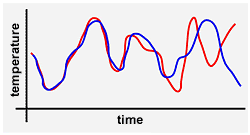
Say, you use a set of equations in a mathematical model to predict the temperature of the weather for the near future.
Say, the model is based on the current temperature, which you read from the thermometer as 13.345423 degrees Celsius.
Say, you get the blue line in the graph as prediction.
Say, you do the same again with 13.345 (rounded) degrees Celsius as current temperature.
Say, you get the red line in the graph as prediction.

You see that even the slightest difference in begin temperature will lead eventually to a huge difference in prediction in the long run.
The graph can be divided in three parts.
The left part is quiet. There isn't much difference between the two predictions.
The middle part shows a difference, but is still ruled by an overal tendency.
In the right part is no correlation between the two predictions at all. All of a sudden chaos rules.
This principle was first discovered in (weather) mathematics, even with very few and simple equations, but it was discovered everywhere in nature and society too later on.

Take for instance the flow of air along a wing. At a low angle of attack (in relation to the speed) the air flows laminar. With a higher angle (and the same speed) it becomes turbulent, but still the overal tendency is to pass the wing and to generate lift. At a still higher angle of attack, all of a sudden the air flow becomes chaotic and the wing stalls.

Chaos theory in chess.
The same you will find in chess.
The slightest difference in initial state can have huge consequences in the long run. There is already one big difference in the initial state: white is to move. Even when black keeps the position quite symetrical, that will make it impossible to keep up with white.
If you take the begin position of chess, you see that the piece activity is very low. The opening is laminar, so to speak. That's why it is possible to learn openings lines. When the pieces develop, their activity increases. That's where the turbulent phase starts. By applying positional knowledge, you can have an influence on the tendency of the game. I now realize that this is what I meant by the steerability of a game.
But then, all of a sudden, when the piece activity increases beyond a certain point, the game becomes chaotic. You have to accept the positions on the board as a random given fact, and try to make the best of it. Here is where brillancy prizes are won.
With every piece that is traded, a part of the total piece activity leaves the board. In this way, when the piece activity diminishes below a certain point, the game becomes turbulent again. And with further trades, it can become laminar again.

These 3 types of flow of the game need 3 different approaches.
Different knowledge, different training methods.

Laminar stage.
The laminar stage, typical the opening end the endgame, require a very specific kind off knowledge. Knowledge that is transferable by books etc..

Turbulent stage.
For the turbulent stage, one have to study mastergames. To get a sense to steer the tendency of the game. This is the phase of subtle judgement and knowing when to break the rules. This is the "Karpovian" stage. As Karpov states, he finds a win by subtle means much more satisfactory than a win by brilliant calculation, since calculation is very error prone and risky. Since you cannot find all the lines, nor your opponent, it has an aspect of gambling for him.

Chaotic stage.
The chaotic phase is where the Kasparovs, Morozevitches and Topalovs of this world feel at home. Here take the fireworks place that is loved by the public. This is the stage that is the most difficult to learn. Here the calculation of concrete variations rules.

We are used to say that Topalov is a tactical player while Kramnik is a positional player. What we mean is that Kramnik loves the turbulent stage while Topalov loves the chaotic phase. I hypothesize that the chaotic kind of play is the strongpoint of all those child prodigies out there.

Montse said:
If you cannot win anymore from a certain strenght of player on tactics, that means also that you are not stronger in tactics but has reached the same level of strenght in your play on tactics as your opponent.

That made me think too. Am I indeed deceiving myself by thinking that I'm playing tactics at a 1900 level and positional at a 1500 level? If I look over the facts again I belief that it is indeed true that I'm a 1750 player. And a 1750 tactician. I assume that I was trying to make certain assumptions true. A bad idea. Painful to admit.

How to master chaos?
Ok, turbulent play can be mastered by studying the masters. But how to master chaotic play?
Take for instance this diagram.


White to move.
This is from one of my cc-games. The game is still running, although we are a few moves further already. SO PLEASE DON'T SEND IN ANY SUGGESTIONS ABOUT THIS POSITION!
That's not the issue I want to talk about with you. This was the position I was looking at while pondering about the above.
It is a position that I consider to be chaotic. Before I can train myself for chaotic play, I must know how to attack a position like this. And I don't know that.
I looked with Margriet for an hour or so but we couldn't find a clue.

This are a few points that arose, in random order.
  • The pieces have a lot of activity. There is a lot going on for both sides.
  • Positional rules/knowledge are of no use here. Concrete variations rule.
  • The amount of variations caused an overload error in our short term memory. That was rather paralizing.
  • At a certain moment we moved the pieces by hand. Although this made things easier, it did not bring us any closer to a clue. Which means that LEARNING TO VISUALIZE future positions isn't going to give us a clue either. It will make things easier, sure, but it will not give us a clue in chaotic positions.
  • There is so much going on that trying to break down the position in combinational elements stranded on a memory overload error either. Even when I started to use pencil and paper.
  • The sheer amount of patterns that are possible relates to the amount of patterns that I have learned as the amount of all the atoms in the universe to the amount of calories in my diet.
  • The answer to the question "who is to move" makes a huge difference for the interpretation of the same geometrical situation.
  • It's possible that there are no winning tactics for white (I think there are). But if there are no winning tactics around, that would be a complicating factor.
  • In the end I made a move. Because I had to. It was actually a gamble. (but probably winning:)
Unless I learn how to crack chaotic positions like these I cannot even think about a training method. All the tactical training and the circles didn't prepare me for this position.

The romantic souls among you don't have to be anxious that I will deprive the game of it's romance with my system building efforts. That is guaranteed by the chaotic nature of the game, which can't be catched in rules.

Monday, February 12, 2007

A different attitude


I'm not a person that draws a conclusion easy. I always like to keep all options open and I like to think that everything is possible. In chess that might mean for instance that I am not inclined to trade off a bad bishop easy. Because who knows, it might become good some day.

I have studied a lot of mastergames lately, which shows that most things from which I think that they might happen, are actual not bound to happen at all. I really have to learn to look different at the game.

On another note, I have decided to change my opening repertoire.
I have played about 8 different gambits and everything what was open and aggressive for both white as black during the past 4 years. Not because I liked that especially, but to learn certain aspects of the game. I have learned alot, and I have enjoyed it.
But now it is time to focus on other aspects of the game. So I am going to play everything what is closed, slow, positional, leads to an endgame and solid for the next 4 years or so.

I have looked after the openings played by the positional grandmasters Kramnik, Karpov, Petrosian and Botvinnik.
I intend to pick up 1.d4 with white, the Caro Kan and the Queens Indian with black.
I really look forward to it. It are openings that are quite alien to me, so I expect to learn a lot. I expect to have an endgame more often, which will help me to motivate for endgame study.

I have no idea if it will fit me, but after 4 years or so I will be able to make a choice which I way to head with my openingrepertoire in the future.

Friday, February 09, 2007

Thematic play

Disclaimer: warning, technical ranting below!

In opposition to what one might think, I'm not ready with tactics. Not yet.
For my level I'm a pretty good tactician. But if you compare it with masterlevel, then you can see that there still is a way to go. The circles are a good way to improve. I have reached the limits of what I can achieve with this kind of training. For now I focus on my other weak areas, but I'm sure there will come a moment in the future I will have to bring my tactics to a higher level.

If I look at it now, doing the circles is a rather blunt method to ingrain only the lowest level patterns into the brain. Although it brought me to 1750, I doubt if it can bring me any further without modifications to the method.
In what directions should I look for improvement of the method? The post of Blue Devil about guided pattern recognition as well as my own experience with Zent Larsen seem to suggest that there are higher structures needed in the brain to guide the process of pattern recognition.

I guess that the inclination to produce such higher structures from lower ones differs from person to person. There are persons who are inclined to draw conclusions based on only a few facts, accepting or unaware of the resulting high errorrate of such conclusions. And there are persons who need an awfull amount of facts before they dare to base a conclusion upon it.
I guess that the former derive the most results from low level pattern recognition training, because they build the required higher level structures which are required to guide the lower level recognition with more ease. Do I still have to say that I reackon my self to the category that needs an awfull amount of facts before I come to a conclusion?

An example.
In the past I studied the thematic bishop sacrifice at f7 (based on 100 problems from Papa Polgar's brick). Since I have done that, I'm much more aware of such sacrifices. Plus it is much easier to see when it is going to work and when not. This is all due to the fact that I consciously builded the higher structures that help me to analyze positions with possible sacs. Wouldn't it be awesome if we could make use of the efforts of other persons to build these structures?

If I will continue in the future with tactics, I will start with experiments to test these guesses. In the mean time I am busy with annotated mastergames from where ever I can find them. So long the annotation is directed to clarify the themes and not just a variation dump. These themes are the higher level structures for both tactics and positional play. Are you for instance familiar with the thematic knight sacrifice at f5 in the Ruy Lopez?
So the study of themes with the aid of well annotated mastergames will be my way to go the coming time. Finally a method where I don't have to invent everything on my own!

Tuesday, February 06, 2007

Another advantage of a gambit repertoire

If you play a repertoire during a long time, you become a person of habit.
A lot of these habits have (has?) grown during a period with lesser knowledge of the game and have become counter productive. The advantage of a gambit repertoire is that you have to replace it some day by a more solid repertoire. At that moment you can get rid of those improductive habits and look with new eyes to the opening. That's the process I'm in now.

Last week I followed a lot of video lectures from Mark Diesen, Pete Tamburro etc.. That is an excellent way to play thru a lot of grandmaster games in a pretty short time. The information is easier passed on than by a book. Especially what is important and what not.
It is good to have some knowledge of the different styles of the respective grandmasters. I'm impressed by the style of Botvinnik which is consequent logical and good to follow. I'm impressed by the style of Kasparov who has very creative solutions for logical problems. I'm impressed by Capablanca who makes things look easy. I'm impressed by Karpov who plays quiet, solid and irresistable.

None of the grandmasters seem to try to steer the game into certain waters. No one tries to avoid complex situations, no one seems to steer to an early endgame except maybe Kramnik who likes to trade queens early. No one shows a biased preference of open or closed positions. So for now I leave the vague concept of steerability as a dead end.

It's great fun to study the mastergames and quite interesting.

Friday, February 02, 2007

The importance of being vague and cheap.

This is a position from the beautiful game Kavalek-Kasparov which I showed you yesterday.


White just played g3 to attack the black knight.
In this position Kasparov played the incredible Nb4!

When I looked first at this position it looked just like a bunch of clogged pieces. I have set it on a board and I look every now and then during spare minutes at the position.
Slowly the position becomes more clear. First I started to look after variations, but there are so many that it is just mind boggling.
When I resisted the temptation to get lost in variations and tried to look with a mere helicopterview I discovered other features of the position.

When I looked at blacks pawns on f5 and e5, the advice of Blue Devil's coach came to mind: if a piece or pawn is very well protected, it probably stands in the way. If you think these pawns away, all blacks pieces can flood thru the gate. Kasparov decides that this uncorking of blacks position is worth a piece. Rybka thinks that he is right. I suspect this to be home preparation from Kasparov, but what an insightfull idea!

So fellow Knights who are busy with the circles, hurry up! And fellow graduates, don't stick with blunt tactics alone, but found your tactics with a positional base. Here you see that tactics and positional play are just complementary. Don't see tactics as an end in itself.

I got a lot of commentary of my fellow bloggers lately that my posts are somewhat vague and theoretical. I'm very grateful for these comments because it forces me to reformulate things.

Effort and emotion.
The point is that it is difficult to get a really good practical useful insight. I mean, we all are pretty booked up on the game, but only when knowledge makes a striking impression you can hope that it will help your play. Only if you got crushed by a murderous bishop pair, you get a feel for the importance of it. If you just read it in a book you say, "aha", forget it and continue as usual.

For instance, I knew theoretically the idea behind the King's Indian Defense. But I never got it to work in my own games. Now I see it by Kasparov, things fall at their place.
Two elements seem to be paramount to make an impression.
You have to make an effort, and there must be an emotional element to it.
That's why it is so difficult to learn something by reading a book alone.

Steerability.
My notion of steerability of a game is very vague.
I will try to explain where the question comes from.
A few months ago I thought that chess was 99% tactics. Being with two captains on a ship, I couldn't imagine that it was possible to make a plan that worked either. Knowing this, my idea was that chess is chaotic in nature. Hence you will always find yourself in random positions, with no idea how you got there, and that you must just try to make the best of it.
If you followed my blog, you will know that at a certain moment I proved that chess is NOT 99% tactics. That raised the question if it was possible after all to make a plan.
So the vague notion that it might be possible that the position you find yourself in isn't necessarily to be accepted as a random given fact lead to the introduction of the term "steerability".

Once you ask yourself questions, however vague, it will change your vision. The questions you have in the back of your head decide if and what you get from a study.
Did Kasparov steer in this game?
To a certain degree you are master of the pieces behind your pawns. Kasparov put them so that four of his pieces looked at only two pawns. Just at that moment he sacrificed a knight to get rid of the pawns. In a tactical way, so that not taking the knight would lead to a difficult tactical problem either. So the asking of a vague question lead to an insight in how to play the KID. There isn't always a clear relation between the question and the resulting insight. But with no questions, no insights.

There are other aspects to it, some of them pretty cheap. For instance can I steer from the opening into the endgame, so that I only have to become an endgame specialist and forget about the complex and difficult middlegame. If there was a cheap way, somebody probably had found it before already. But these questions do no harm and can even lead to insights, so I don't mind. In a way the investigation after closed position was a cheap try to get rid of those migrainogene complexities of open tactical games:)

Thursday, February 01, 2007

Steerability and closed positions.

Today I studied an awesome closed game of Kavalek vs Kasparov. It was annotated by Mark Diesen from chess.fm who says that in closed positions often the usual value of a piece has no meaning. What matters is the total amount of attacking pieces that you can redirect to the side of the board where the action takes place. If that amount is greater than the amount of defenders, it is often time to sacrifice. Because the defender has little space at the side at which he is attacked, he cannot find always the right defending moves. Once the king is naked, the remaining attacking pieces can cash in.

This is shown in this beautiful game here.
So maybe the idea of steerability of a game in relation to closed games is just nonsense. What is certainly nonsense is that there are less possibilities for tactics in closed positions. Maybe even the opposite, if you look at this game and Mark's comment.