Saturday, June 30, 2007

Tournamentplay


We just submitted for the Dutch Open Championship 2007 in Dieren. That runs from july 24 to august 2. Nine games 40/120,SD/60 swiss.

Right now I'm pondering which trainingapproach would be best. I see 3 things I like to do:

Blindfold/visualization.
According to my own arguments blindfold chess will not improve my chess. Poor visualization skills can impede my reasoning though, so that I play below my level. Since my arguments are usually wrong, I might give it a try.

Reasoning.
Since my latest discovery of a technique to store patterns in LTM by conscious and painful effort, I'm pondering how that can help my reasoning. I don't know yet. I'm convinced it is possible, but I have no inspiration.

Endgame strategy.
Analysing my own games, I see that I have no standard endgame plans. I have done a lot at endgame technique, but I have no overview over the area. Simple plans like when I must try to trade off to an endgame with bishops of opposite color, or when must I not swap the rooks etc..
Possibly a simple list with when must I head for what can be of great help. I will give this a try.

Thursday, June 28, 2007

Building quadrants.

Conscious effort is unpleasant.
My board visualisation exercises gave me a clear framework consisting of diagonals. The key of the exercises is that you make a conscious effort. The automatic pilot is tabu. Conscious imagining of the details will commit these details to LTM. You can easy test if something is committed to LTM: it shows immediately in the next exercise. Don't let the brain deceive you by its brilliant trick to reconstruct instaneously what you are looking at. The difference is simple: a reconstruction fades away easy while something stored in LTM doesn't. With conscious effort you can make great progress in little time.

But it isn't pleasant to make a conscious effort. It is difficult to keep the focus of attention on the right spot. It is much easier to sit back and let the automatic pilot take over. The brain is very resistant against conscious efforts. Maybe I should say lazy. I hope that things will get easier after more exercise.

Fill in the details.
Now the outlines of the diagonals are clear it is time to fill in more detail. When I imagine the diagonal a4-e8, it is easy to see the squares a4 and e8. But in between it is rather fuzzy. It is not immediate clear how many squares there are in between for example. Or how the diagonal crosses other diagonals.
So today I started with trying to "build" quadrants out of squares, while focussing on the white squares. The quadrants were build quite from memory since I hadn't seen a board for 8 hours. Which means that all the elements are already in your memory, you just put them together in another way. After I had build all quadrants I fitted them together. Just a few days ago I had called this exercise way too complicated. As a rat running around in circles I come back to the same exercise and find it to be relative easy. So the order must be that you work from outside in. First build a framework, then fill in the details. When you work the other way around you tend to lose sight too easy.

Blindfoldchess.
Every day I play a few blindfoldgames against the the computer. I let the computer play at a pretty low level, since it is an exercise in visualisation and not in reasoning. I use an empty board since I do already separate exercises for board visualisation.

I don't have the feeling that I made any progress with blindfoldchess last week and I think to know why. When playing blindfoldchess I tend to play on the automatic pilot. So I learn nothing from it. Next week I will try to put in conscious effort, let's see if that makes a difference.

Reasoning.
In the mean time I make little progress in my reasoning. I discovered from Polgars book that the middlegame has 77 different classes of positions. So that gives an idea about the amount of work ahead.

Storing patterns in LTM.
Is conscious effort the panacee to commit patterns to LTM?
It sure looks like it.
Can it be the missing element in MDLM's method?
I tend to think so. Since MDLM is the developer of his own system he possibly did his program with a conscious effort. Since we got the method "second hand" we were inclined to do the exercises on the automatic pilot. Hence with less result.

Maybe I see this conscious effort stuff way too rosy. If so, I trust that reality will soon catch up. If not, I might better call it Conscious Effort (TM).

Wednesday, June 27, 2007

Virtual boardconstruction

Today I thought I was a bishop


I'm making a huge progress with board visualization. When I started with exercises a few days ago, I saw just one black sheet before the minds eye. While starting my exercises I saw only 10% light at the places where I imagined the lines. The image was very distorted, scattered and dark. Yesterday and today I added a new exercise. I imagine a bishop trotting over the diagonals. First from rim to rim, later criss-cross over the board. Now I see about 60% of the board, especially where the bishop is. The other edge of the board still remains in the dark. It begins to look just like an ordinary chessboard. Since I know exactly what I'm after, the exercises are much more effective.

What can we make of all this?
I'll try to give it a shot.
The brains are very efficient. When it isn't absolutely necessary, images are not stored in the long term memory (LTM). From any subject only a few outlines are stored in the LTM. You can exactly see what is stored in LTM. That is what you see when you close your eyes and try to see the subject with your minds eye. A very distorted picture. To camouflage this, the brain makes use of a brilliant technique: reconstruction. Within no time the brain is able to reconstruct the image from the few elements that are stored. So that it looks just like the whole image is there. But when you look at the details you will find that the brain is cheating you. Look at a picture of a motorcycle in your minds eye.When your eyes glide along the picture and you look at the handle bars, the rest of the motorcycle is hardly visible. You don't see the details of the sissy bar. When you look at the sissybar, you don't have a clear picture of the front tyre. The details are reconstructed by the brain before your minds eye just when you decide to look at it. This economical use of resources in the brain has only one downside. It makes use of the short term memory (STM). Which means that it fades away after only a few seconds.
Which is especially annoying when you are trying to imagine a beautiful combination on your virtual chessboard.
Disclaimer.
All this waffling is just an attempt to clarify the facts I'm observing. It has no scientific backup whatsoever.

Let's, for the sake of reasoning, assume that the above is true. What conclusions can we derive from it?
First of all the described exercises are a method to store patterns in LTM. Which is the holy grail of chess development.
Recently in a scientific paper about cognitive research the researcher posed the important question: "What we don't know is why a grandmaster assimilates all those patterns in his LTM while the amateur who studies the game for decades does not."
The clue must be within the exercises above.
Years ago I have exercised on the website of Jan Matthies for weeks, maybe months on end. But it didn't give me the same improvement as now. What I want to stress is the importance of precision. While I did those exercises I didn't quite know what I was after. And so an immense effort was wasted because the exercise didn't adress the problem properly.
The brain is very resistant against uneconomically use of LTM. Even if you look at a chessboard for decades the brain is not impressed and doesn't store the diagonals in your LTM. Only if you make the effort to consciously look over all the details of the diagonals in your minds eye the brain is willing to store the pictures in your LTM. Once that is done your STM is freed from to obligation to reconstruct the pictures all the time and has free space for more useful tings.

I am well aware that I have builded a big building on little fundament. We'll see if it lasts.

Tuesday, June 26, 2007

Attacking complexity

Still developing a strategy for complex tactical positions.
There are two problems here:
  • The positions vastly differ
  • Within a position the complexity is caused by the sheer amount of simple motifs together with their interference.
The positions vastly differ.
First of all an inventory must be made of the different kind of positions. Since I only research one position per 5 days or so that will take some time. Besides that I have no idea how many different kind of positions there are, so maybe it isn't even doable. But I don't worry about that, over time I will know the answer on this.

Within a position.
How do you "attack" a certain position? What should be your problemsolving strategy? What questions should you ask yourself to find your way in the maze?
In a position I'm pretty fast "overwhelmed" by its complexity. When there are too many things to be stored in my short term memory (STM), I just tend to get paralyzed.
So I try to develop a strategy how to handle this. One possible strategy could be how to avoid such positions. Another possible strategy could be how to gamble on the best move. But for the moment I try to break down complexity in it's simple elements. Once that is done I try to "generalize" the approach of these simple elements so that it becomes available for all kinds of the same sort elements. That sounds difficult and that is what it is.

I will try to give an example.
As Blue Devil stated a long time ago, counting during trades can be difficult. By that time I waved that away, but now I have to admit that he was right.
Usually when all trades happen at the same square, it isn't too difficult for an experienced player to keep track of the movements and the traded values.
But if your Queen is attacked and in stead of moving her away you decide to counterattack by attacking the queen of your opponent, then you have to keep track of two series of moves at different parts at the board. When you add to this the bookkeeping of the trades, then it is amazing how fast your short term memory overloads. Limited space in your STM = complexity. So I'm looking for a method of counting which is less taxing for my STM.
As long as I don't encounter an dead end, I will try to work out this kind of submethods. For now I'm not ready yet for a strategy of avoidance or gambling.

STM vs. LTM
My experience during a blindfold game lately made me think. The fact that I could remember the position even after an unintended break of an hour, means that I use my LTM as an extension of my STM. The skill to use your LTM as an extension of your STM is what the expert distinguishes from the amateur and the clubplayer from the homeplayer. That is what is shown by brainsscans during cognitive research. The $10k-question is: How do you acquire that skill. What is the optimal trainingsmethod?
Answering these questions may make the need to simplify positions to avoid STM-overload unnecessary.

Sunday, June 24, 2007

More about board visualisation


Loomis said lately that he plays better blindfoldchess when looking at an empty board. I experience the same. So that's a plea for board visualization. I have done a lot of visualisation exercises at the website of Jan Matthies years ago and at a certain moment I got a chessboard with pieces before my minds eye which I could handle just like a physical set. It only lasted for a few minutes though. So I have a reasonable idea what is needed for perfect visualisation. I don't think that the system of Jan Matthies is very efficient, although it works in the end. Further I noticed a lot of methods around the web that break up the chessboard in quadrants, which you have to put together later on. If those methods work for you, good for you! But for me that looks way too complicated.

There are 3 kinds of movements on a chessboard. Straight-, diagonal- and knightmovements.
Straight movements are very easy to imagine before the mind's eye, since we are used to rows and columns since our youth. The diagonals are very wrinkled usually.
This is my method to iron them out:

Let's have a look at the darksquared bishop. There are 4 rectangles which cover the whole board:


The blue line is "a special case of a rectangle" (please be flexible). Imagine these 4 rectangles one by one before the minds eye.

Any dark square is a "member" of one or two rectangles. On the rim it is a member of only one rectangle, in the middle it is a member of two rectangles.

Take for instance square d6:


You have to imagine before your minds eye the two rectangles which go thru d6. When you do this for every square, all the wrinkles disappear! With the light squares it works all the same in mirror view.

With this exercise, the movements of the rook, bishop, queen, king and pawn should be no problem anymore. The knight is quite a different animal, at which I hope to come back later.

Besides visualization exercises and blindfoldchess I'm still working on "reasoning".

Saturday, June 23, 2007

Blindfold chess.


Today I played a blindfold game and after 40 moves I took a break during an hour. After that I continued. It proofed that I had forgotten the location of only one piece from the 16 left pieces. That was because I had not taken the last move into account. I remembered the piece at its previous location, which is some kind of interference. This means that with blindfoldchess I commit the location of the pieces in my long term memory!

This reminds me of a story of GM Timman who refused to train a few young masters since they weren't able to remember their last played game without a score.

I have adopted a trainings regimen for blindfold chess and board visualisation of one hour per day. I guess that the standard must be that there is no or little difference between playing with or without a board. At that moment the lack of visualization skills will no longer interfere with my chess and cost me points. Are there readers around who have experience with blindfold chess during a longer period of time?

Today I start to have a closer look at "reasoning". Now let's see. . .

Friday, June 22, 2007

Board visualization, does it matter?

Blue Devil put up this important question in his latest post. So read this as a comment on his post. Blue Devil's question was inspired by a scientific article of Gobet&Jansen 2005. Based on my latest research I belief it is possible to give a definite answer to this question.

My conclusion has much in common with the article of Gobet, with one big difference though.

In my latest research I found 3 different aspects of solving a position:
  • Reasoning
  • Seeing a series of moves in the mind's eye ("blindfold chess")
  • Board visualization
Being a patzer is for 99% caused by the fact that I suck at reasoning. I don't know how to "attack" a position. So if I want to get better at chess, this is the problem to tackle.
If I can't solve a position while looking at a physical board, and allowing myself to move the pieces on a second analysis board, then I can certainly not solve it blindfolded. Because that only makes it more difficult and not less.

On the other hand, if I, struck by a moment of enlightment, all of a sudden forget to suck at reasoning and get a brainwave how to solve the position, wouldn't it be a pity if I screwed that unlikely precious moment up by poor visualization skills?

So the conclusion can be:
Blindfold chess is not a way to improve at chess because it doesn't teach you how to handle difficult positions. At the same time not being able to play blindfolded can get in the way once your reasoning is able to solve the position. It is the reasoning that decides which moves are candidates and their priority.


About boardvision I have not decided yet. I'm inclined to think that that it is a form of luxury, with which a chessplayer should treat himself, just like he would do with a beautiful wooden board and pieces. If there is a beneficial effect from it to use it as steppingstone as suggested in Tisdall's theory has to be investigated yet.

It is usually advised to solve a position in your head, without moving the pieces.
I advocate to commit the heresy not to do it that way. Since that is actually to play blindfold during the reasoningprocess, which lowers the quality of the problems you can handle.
I advise to make 3 seperate exercises from this in stead of to try it at once:
  • Exercise of reasoning
  • Exercise of blindfold chess (use low level opponents!)
  • Exercise boardvision.
And that is what I'm trying to do.

DK Transformation.

In order to see a sequential series of weathersatellite-images I removed lately the animation blocker that images prevent from moving, flashing etc.. All of a sudden the image of Blue Devil started to rotate again at his blog. Which reminded me that he found blogging a quite self-indulgent occupation. However I don't feel it the same way, sometimes I'm worried indeed when I count how ofen I use the word "I" in my posts. So when DK Transformation wrote a flattering post about me my first reaction was to write a post back without using the word "I" in order to do some penance for my vanity. But to my shame I soon realized that that would be impossible to me. So here it is, a post about DK, with my favorite blogger - as DG would put it -, me, included.

The most eye catching of DK is, is that he is a warm person. Most people who are used to look in their own minds instead of looking around them, with me as an exponent, experience a lot of coldness in their own thinking. Then it is a relieve to meet a warm person. It is evident that he values his feelings higher than his thoughts, and I suggest the reader kindly to follow him in that.
With his sensitivity he stands closer to the deities, who by their nature use very volatile and highly powerful energies to communicate. No wonder he has no time for capitals or correct punctuation when he translates their musings for us mere mortal souls! And of course he cannot allow his mind to filter anything they say.
He feels much compassion for me who is imprisoned in his own mind, worshipping the inner god called "logic". He kindly tries to wake me up with "that what isn't said". However I feel he's right, I cannot, no matter how much I try.


His compassion stretches even to what I would call inveterate persons. But miracles do happen and Chessdog seems to have really changed lately.


Although we differ vastly in psychological type we do have a few important things in common indeed as he righteous feels. First we both are prepared to follow consequences till the end. He from what he feels, I from what I think. Secondly we both are greatly influenced by Gurdjieff and Ouspensky and have undergone "inner work". Thirdly we both have something of a child left in ourselves.

And further we both love chess.
However not everything has been said, I'm sure he will understand.

Thursday, June 21, 2007

The weakest link

The whole process of analysing a tactical position can be divided in 3:
The reasoning, seeing the moves, visualize the steppingstones.

Today I tried to visualize the whole tree with 25 branches and 125 moves from the position of Kotov's book. I was pleasantly surprised that that was fairly easy. The start was somewhat difficult, but I began to feel stronger and stronger while progressing. After a few hours it wasn't a problem to reconstruct the whole tree complete with my eyes closed. So this makes it quite clear that the reasoning is the weakest link by far.


I intend to exercise all 3 techniques apart. Since I'm so bad in reasoning, I intend to make use of ROS (TM) Reasoning Out Loud in stead of inner speech. Further I allow myself to move the pieces by hand to make it easier so I can concentrate on reasoning. After I solve all elements of the position and after checking it against the solution and the computer, I will close my eyes and visualise the whole tree. I really look forward to it.

The poor image that is procuded by the physical eye is enhanced by the brains to a beautiful picture. It's a pity that we can't use that brainpart to enhance our poor image which we create during visualisation with the mind's eye.

Wednesday, June 20, 2007

Improve your chess NOW

Yesterday I picked up a second hand copy of Jonathan Tisdall's book "Improve your chess NOW". Hattip to Blue Devil. These are my first impressions.

Alexander Kotov formulated for the first time a fundamental theory about chess improvement and especially about calculation improvement by means of the tree of analysis.
He hardly can be enough honoured for that. At the same time, while reading his work I realized that his idea's had to undergo some modification to make them applicable in practice. This doesn't detriment his original idea's, but adapts them to practical use.

While I was developing these thoughts, Blue Devil pointed on Tisdall's book. Tisdall has used the method of Kotov and developed it further by adapting it to practice. Two new idea's stand out in the first two chapters.

First Tisdall describes a method of "internal speech". During analysing a position you talk to yourself like "f8 is the only way the black king can escape mate, how can I prefend him from going there? Ah, Bc5 will prevent that!" etcetera. I already had realized the importance of internal speech while reading Kotov.


Second he advocates blindfold chess as a method to improve your calculation skills. He proposes (in my own words) to visualize the positions at the knots of the tree of analysis as stepping stone for the calculation of the following series of moves, thus hopping from knot to knot.

One thing his chapter about blindfold chess shows is that there is a lot of confusion about the used terminology. And indeed that needs a lot of refinement.
To give an example:
If blindfold chess leads to superior calculation, you would assume that blind people would all be of expert level at least. Since this is not the case, blind people do something different than what we use to call blindfold chess.
I have played a few times against a blind guy. He has a special board and feels the position with his fingers continuous. He has the same problems with projecting the future positions before his mind's eye as everybody.

While playing blind I can beat most non-clubplayers. But when I play a complex position then there are 3 elements that play a role. First the visualisation of the stepping stones. Second the calculation of the series of moves that leads to a new stepping stone. Third, the problem at hand. If you can't solve the problem, the other two are of no use.
While playing blind against a non-clubplayer, the third point doesn't play a big role. Since I can beat them anytime, the problems I have to solve are very simple in general.

All this needs to sink in and needs more testing. All my previous conclusions about visualisation are in need for an overhaul and need refined terminolgy and definitions. Exciting times lie ahead!

Tuesday, June 19, 2007

Calculation

The position below is a great exercise of Kotov's book "Think like a grandmaster.

Diagram 1


Black to move, white to win.

White threatens Qh6 which leads to mate or big material gain.
Black has 5 reasonable defenses:

1. Kh8 (14) to defend h7 with the rook
2. f5 (19) to let the queen help in the defense
3. Bxd5 (45) to capture in important attacking piece
4. Rae8 (15) to defend f6 with a rook
5. Rfe8 (29) ditto

The figures between parentheses are the amount of moves of which the main branch exists (usually split in different branches of a higher order).
The idea is to analyse all logical lines until white wins.
I suggest you try it for the first option of black: 24. . . . Kh8 which has only ca 14 moves.
You can write down all the importants lines you find.
Solution:
[24. . . . Kh8 25. Bc5! Qe6 26. Be7!! Bxd5
(26. . . . Rg8 27. Bxf6+ Rg7 28.Qg5 Rag8 29. Ne7! Qe7 30. Bxg7+ wins the Queen while every other 29th move wins easy)
27. exd5 attacks the Queen and threatens mate at h7]

To analyze all important lines you have to investigate about 125 moves, which will probably take you a few hours. And even then you will probably find that you missed quite a few beautiful combinations. This is really a great exercise! Which brings me to the following inevitable conclusion: there is no difference between calculation and blindfold chess.

Monday, June 18, 2007

That's the question


The question.
In my previous post I formulated my question. Without a question you can't get an answer. So defining the question is all-important. Today I started to look for answers in Kotov's "Think like a grandmaster", a book that I only had glanced thru once. I did some testpositions and the results were pretty revealing. Especially if I take the position into account too on which I worked for 7 seven days lately.

The misconception.
I used to think that the difference in calculation skills between amateurs and grandmasters wasn't that great. That the real difference was made by the amount of patterns each could recognize. In fact that was what prof. Adriaan de Groot stated somewhere in his scientific work. But now I found out that that is not true.

If the problems of Polgars book and Kotov's book are the standard, then grandmasters can calculate much better than me. What is more, my latest experiments with deep calculation convinced me from the fact that I can do much better than I do right now. The idea that I have reached my upper limit of calculation skills is utterly nonsense. I have just deceived myself with that idea.

Lately I read a scientific research which refuted the statements of prof. de Groot.
Prof. de Groot based his conclusion that amateurs and grandmasters don't differ much in calculation on research with rather simple problems. But the refuting study was based on much more complex problems and a big difference in calculation skills was shown. So the accent of my work shifts from pattern recognition to developing more calculation skill.

Sunday, June 17, 2007

Summary

For the unlikely case that you missed the cohesion in my posts the past months, I have summarized a few issues.

Classic MDLM.
The results of 100k+ tactical exercises in "traditional" MDLM style have convinced me of the fact that there is something MDLM didn't tell us. Because he didn't know, or didn't know that it was important. If I look at the ratingprogress of the Knights, and I distract the ones who started with a rating that was either provisional or below 1400, and the ones that weren't adults at the time of exercising, than no one has come close to the results of MDLM. I do belief that if you are rated 1500 that the circles or other intensive tactical training can help you to gain 250 points. As it did to me. If your rating is below 1400 and/or you aren't adult, your ratingprogress can be greater than 250, maybe even until 500. And that if you start with a 1800 rating that it can help you to add another 150. But the fruits are finite. I assume DK would call it the law of diminishing returns. Since I'm of the school of Henry George, I start immediately to stretch the fixed parameters and to introduce new ones.


Conscious effort.
The education of the chessmodule in your brain is for 1% based on consciously and serial focussing of your attention and for 99% on unconsciously, semi-intelligent parallel processing of data. What is processed by the unconscious part of your chessmodule is based on what happens in the 1% conscious attention you give.
Since the unconscious part is semi-intelligent, the quality of the conscious effort is all-important.

Feedback.
The improvement of your chessmodule is based on conscious feedback. Feedback has 3 elements:
  • You make an error.
  • Some aid corrects your error.
  • You consciously try to assimilate the correction.
You can't correct your own errors. If you could, you would not make them in the first place. Trying to correct your own errors is what I think to be the greatest flaw in the circles. That takes a terrible amount of time with a result that isn't in comparison.

To find an aid to correct your errors there are 3 options:
  • Hire a coach to analyse your games and to play as your chess mom.
  • Buy a book with games/positions from mastergames and with grandmasterly comments. Try to find the moves first yourself in order to make the necessary errors.
  • Take complex tactical problems and use a computer to find the correct lines.
Complexity.
I opt for the third solution. In about 70% of my games I am confronted with positions that are too complex for me to handle. Maybe it is more than 70% but can't I see that because of a blind spot, who knows? It looks just logical to work on my ability to handle these complex positions. Any strategy that works is fine. I tried to adopt a style to avoid complex situations, but that didn't work. Even the masters of positional play weren't afraid of complexity and could handle it.

Now I'm using Polgars middlegame brick which has complex middlegame positions with a finite conclusion aplenty. Most positions are highly tactical. The solution at the end of the book plus the computer are the assistants to correct my errors. The positions are derived from grandmaster games, which means that grandmasters were able to handle this complexity.

Problem solving strategy.
I have no strategy to "attack" such complex problems, so I try to find one.

Thursday, June 14, 2007

Muddling thru


I'm still drudging in the mist with the same position. 5 days for 1 position is not exactly blitz, but I just saw the outlines of Monroi so this must be another limbo.

Tuesday, June 12, 2007

Wouldn't it be nice?

Still working on the same position. I'm now researching the very effect of every move. The effects of a single move can be divided in two parts. First the effects of leaving an empty square behind, second the effects of occupying a new square.
King of the Spill has an elaborate post about this subject here.
His idea's have to be simplified though to make them suitable for practical use. That's what I'm trying to accomplish now.
What is the effect of a single move on the potential invasion squares where your pieces converge?

As it is now, when I play a game, the subsequent positions happen to me. To a certain degree, every position is new to me. Just as this neuroscientific research showed as being the difference between a patzer and a grandmaster: the patzer sees everything as new. When seeds of tactical destruction arise, I have no idea where they come from. For me, they come out of the blue.

I can only hope that when such seeds do arise, no matter on which side, that I recognize them. You can hardly call this conducting a chess game. I'm totally dependant of the coincidences of the game, and can do no more than to hope to recognize these coincidences in time.


Now wouldn't it be nice if I could be aware of all important changes with respect to the seeds from move 1? Especially my newly invented seeds:
  • Squares where piece activity converges.
  • (Overworked) pieces that defend those focal points.
  • Impediments beteen pieces and the focal points.
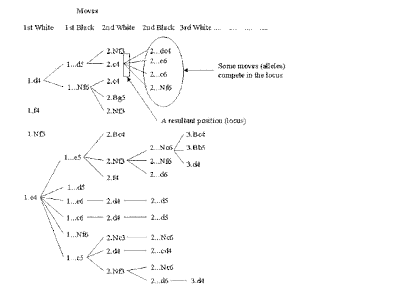
The beginposition has no focal points. Or you have to consider f7 to be a focal point of the second order. In that case 1.e4 can be seen as removing an impediment for two pieces which via the newly opened diagonals are 1 move closer to the focal point f7.

When you can keep track of the impacts on focal points every move, winning sequences no longer appear from out of the blue.

Monday, June 11, 2007

What if

Today I spent another few hours at the same position as I showed you yesterday. I asked myself, or Rybka to be precise, what if I make this minor adjustment to the position? What if I remove this pawn? What if I take back with Nc6 in stead of Nd7 etc.?

The answers of Rybka showed me a whole lot of details which influence the evaluation of the position. It's hard to believe the amount of motifs that I missed! Now I understand why someone who does see all these details can crush me time and again. For instance I totally missed the importance of e6, which gives white extra mating possibilities under certain circumstances.

With the aid of Rybka I could find out what the bishop sac on h7 actually accomplishes. It's main effect is to prevent h6, which would shut off the white queen from h7.

With such semi-total chess blindness, it is evident where the focus of the study must be. So 4 hours of study for such "simple" positions as this is way too little, as DK already pointed out.

Sunday, June 10, 2007

Alto-deaf


When I listened to music in past times, I used to hear a blur of noise. I liked The Doors, Pink floyd, Kraftwerk, Iron Butterfly, Led Zeppelin, Deep purple, Black Sabbath, Big Band etc..
Basically that was because I was a musical barbarian.

Since 4 years I sing as bass in the choir which is conducted by my wife Margriet. We sing a cappella 4-9 voiced works from the Renaissance mainly. When I started I had no musical background at all. One of the first things I noticed is that I wasn't able to listen to . . . , well to anything actually. I even didn't know how to listen to my own voice.

You can only learn something, if you know that there is something to learn. If you don't know there is something to learn and nobody tells you, you can't possibly learn something. Even if you are potentially capable of learning.

Even getting help from somebody who has already learned it is problematic. Since they have often learned it as a kid, they are not AWARE from the fact that others can have a problem with something that is so natural to them. So I don't know which questions to ask, while the expert has no idea what the problems could be.

When I listened to a 4 voiced piece, I realized that I didn't hear the altos. The voices of the sopranos and the basses are easy to spot. The middle voice is easy to identify as the tenors, but where are the altos?

If I hadn't known that it was a 4-voiced piece, I hadn't known that I wasn't hearing a voice. But since I know now, the learning can begin. And so I started to listen daily, focussing on the altos. Within a few weeks my ability to hear the separate voices has grown immense.

And so it goes. It takes 48 years to become aware that there is a problem hidden in the blur überhaupt, and then it takes a few weeks of seriously focussing to cure it.

The same is true for chess. Of course.
See the following diagram:

diagram 1


White to move and win.

It will probably take you a few minutes of forward thinking to come to the following line:
1.e5 Ndxe5 2. Bxh7 Kxh7 3.Ng5+ Kg8 4.Qh4 g6
Then it becomes a little fuzzy how to continue. 5.Ne4 seems to seal the deal but black has resources that you easily overlook while looking with "your minds eye". Not that black can withstand the attack, but how can you know? Usually we would go to look after the solution at this stage, see that the variant with 1. . . . Ncxe5 wins also for white and continue to the next problem.

Now let us think backwards in order to see if we missed some singing voices.
First we have to acknowledge that in order to gain something from this position, the target must be to mate the black king. It will not take much time to see that there aren't any simple material-gaining tactics around.
When we aim at this target of mating the black king, we either hope to mate the monarch or that black has to give us a lot of wood in order to prevent us from doing so.

White's rook on f1 divides the board in two parts, and the chances of the black king to be mated lie mainly at the right side of that file. The square h8 deserves special attention. To prevent h8 to be a refuge for the black king, we identify 3 white pieces which can cover h8:
The bishop on f1, one of the knights or the queen.
If the bishop or knight covers h8, the covering of g8 and h7 will be problematic. So the most chances for mate or the threat of mate lie with the white queen.

Now let's have a look at the two newly identified seeds of tactical destuction:
  • Squares where piece activity converges.
  • Overworked pieces that defend those focal points.
First let's see how white is doing.

h7
Bd3, Nf3 and Qg3 all converge to h7. I consciously overlook the impediment e4 at the moment.

g7
Bc1 and Qg3 converge at g7.

f7
Rf1, Nf3 and Qg3 all converge at f7.

Now let's see what black has in store to defend these focal points.

h7
Kg8, Nf6 and Qc7 all converge to h7. I consciously overlook the impediment g7 at the moment.

g7
Kg8, Bf8 and Q c7 converge at g7.


f7
Kg8, one of the knights and Qc7 are able to defend f7.

Why are these focal points so important?
If you have the upperhand at one of these squares, such square can act as an invasion square. All the moves that are made have an influence on those potential invasion squares. As white starts with e5, he has little more reason to do that than to give his bishop on d3 access to h7. If black decides to take on e5, how must he do that?
Ndxe5 removes itself from the row where it hinders the black queen from access to h7. At the same time, the knight itself is lost for the defense of h7. If black takes with Nc6xe5, no progress is made for the queen to access h7.
Not taking on e5 has as side effect that the square f6 is no longer available for the black knight to defend h7.

So what's the score?

h7: 3-3
g7 : 2-3
f7 : 3-3

From these, h7 offers the best chance, since black needs two moves to remove the impediments while white needs to remove only one.

Now what can we learn from all this?
The difference between the expert and the patzer is that the expert sees more. Compare the difference between two persons of which only one knows the rule of the square in an pawn endgame. He who doesn't know the rule, has to imagine the king and pawn running to the other side in order to find out if his king is able to intercept the running pawn in time. While he who sees the square in his minds eye, knows instantly if he will be in time without hesitation and without errorprone calculation.

This diagram is a relative simple problem from Polgars book. I'm used to forward thinking, but even in this simple position I got lost after move 4. So when I should play 1.e5 in a game, it would be a highly speculative pawn sacrifice.

With backward thinking the attention shifts from the pieces to the squares. The patterns you see are imaginary AND real. It gives a framework to analyse every move with respect to its effect on the focal squares.

Of course it is a lot of work to identify all this for only one position. But hey, look how commonly placed the white pieces are. If I got a beer for every game of mine with the pieces placed exactly like here, I would have a delirium by now.


Seeing new topics makes the game more enjoyable. Just as hearing more detais makes the music more enjoyable. Hear, hear!

Saturday, June 09, 2007

Second area of attention

Those chessvideo's are great! You can learn a new opening in 2 days and play it with confidence. Today I played against the clubchampion (2140).
I played a new system against the Caro Kan, which he always uses with black. I had spent only two evenings at this new opening. I was better in the opening, in the middlegame and in the endgame. My tactical meditation seems to bear fruits. He admitted that I should have won this game, but in mutual time trouble I blundered an important pawn away and lost. You can find the game here.

The point is, I have done a lot of endgame exercises, but I don't have standard plans. While learning endgames I focussed on the details but I have no overview. Endgames are almost always played in time trouble. So there is no time to develop plans, I must have standard plans.

So the study activity for the coming months are evident:
Next to meditation on Polgars brick I will try to develop standard endgame plans.

Thursday, June 07, 2007

More seeds


If you use 4 hours per problem, it almost approaches meditation.
The seeds of tactical destruction as Dan Heisman calls it are already well incorporated in my thoughtprocess. That is to say, I can't avoid to look at these issues in a position.
I'm pondering about more seeds of destruction for more complex positions. So far I have found two new seeds:
Squares where piece activity converges.
Overworked pieces that defend those focal points.
More on this after more meditation.

Wednesday, June 06, 2007

Thinking backwards


Kotov popularized the so called tree of analysis in his book Think like a grandmaster. Other authors, like Nunn in Secrets of practical chess, revisited this idea a little further. The tree of analysis is a method of forward thinking. The downside of forward thinking is, in a complex position, that the amount of branches grows sky high before you know it. With many branches and many moves, a short term-memory overload error is inevitable. And that is time and again what I experience when solving complex positions from Polgars middlegame brick when I use the method of trial and error.

A better method would be to think backwards. That you recognize the endposition, and try to find moves that lead to that position. In a sense, Dan Heisman's seeds of tactical destruction is a method to think backwards. This works much better, because the load of the short term memory is diminished. But the "seeds of tactical destruction" is a rather limited system, and insufficient to solve the more complex positions.

And so I'm looking for a more elaborate system. I came to the same conclusion in this old post. Since this is the second time I reach this conclusion, but now coming from another angle, it makes me to belief that it is important.

Tuesday, June 05, 2007

Polgar 6 - Rybka 6 - TS 0

So far I have been investigating 12 problems from Polgars middlegame brick. I wasn't able to solve a single problem without aid. When I read the solution, I often had still no "aha"-experience. Only after 4 hours messing around with Arena, I got the feeling that I began to grasp the essentials of the position.

From the 12 solutions, 6 were busted by Rybka. Which means that even grandmasters are often wrong in complex tactical positions. Hisbestfriend posted about the same phenomenon in Euwe's book.

It is time to draw a few conclusions, in order to direct my future study. After an impressive detour I'm back again at complex tactical situations. I used to have the idea that if I do enough simple problems, that would be the road to learn to do the complex problems. After solving 100k+ problems it is proven that this idea is wrong. I couldn't even solve a single problem from Polgar's book! (since I restarted a week ago)

The coming time I will focus on complex tactical problems from Polgar's middlegame book. I don't know a better method than to use 4 hours per problem. At least I skip the unviable approach with trial and error during the first half hour or so, hoping for inspriration. After a few minutes I go immediately to the solution. Of course I will try to find a method that takes less than 4 hours per problem, but at the moment I haven't a clue how that kind of study should look like.

Monday, June 04, 2007

For Loomis

Loomis asked me:

I'm very interested to see an example or two of problems that you spend 4 hours on. I have a feeling that I don't have the discipline that you do to spend that much time on a problem. :-).

diagram 1


White to move.

diagram 2


White to move.

I don't look at this as actual problemsolving. I see it as an investigation.

The main question is: how can I solve a position as this OTB in 3 minutes (the average time per move).
I use a few minutes in an attempt to solve it. Then I go to the solution and work out all variations with the aid of Arena.
Then I try to find out why I missed what I missed. Then I try to found out what the specific characteristics are of what I missed. What is needed to recognize all important elements of the position within 3 minutes? What happens in my mind? What kind of exercise would I need to train this?
So it isn't a matter of discipline to look for so long at one position. It is a matter of curiosity.
Since the questions I ask myself are the same, it doesn't matter if I investigate 1 problem or 100 problems to try and find the answers on these very questions.

My latest discovery is (the importance of) interference.
My penultimate discovery was that there is a difference between the series of subsequent moves (with moves A, B en C as seperate moves in time, my usual way of looking at a position) and a geometrical pattern (where A, B and C are visible at the same time in one spacial pattern).

Sunday, June 03, 2007

Interference


Still busy with Polgars middlegame problems in order to find out why these are so difficult. 4 hours per problem is de facto the average time I need to investigate all ins and outs with the aid of the solution and the computer!

Every problem has a certain amount of basic tactical motifs. It is doable to find these.
The complexity stems from the interference between motifs.

Say, you fork a bishop and a knight with a pawn. Simple and winning. But if the bishop can participate in a counterattack, this interference makes it complex.

And so I'm trying at each problem to chart all basic motifs and all interferences.

Friday, June 01, 2007

What was a pattern again?

For the first time, the investigation of 8 problems from Polgars middlegamebook took me 2 hours per problem. In these two hours I made myself familiar with all variations of the solution, with the aid of a computer.

Now I'm revising the same problems again, which takes another 2 hours per problem. The investigation narrows down to the following: how kan I translate a series of subsequent moves IN TIME into a geometrical pattern IN SPACE?

In order to train patterns, you must first have a pattern, right? And a pattern is geometrical, right? The transformation of subsequent moves in time into a geometrical pattern doesn't happen automatic. A conscious effort is necessary.

Update:
I got a comment from a guy named Mocca on my previous post about pesky weeds.
He feeds the suggestion that he is somehow related to Monroi. I answered him.