Posts

Rookending continued

Image
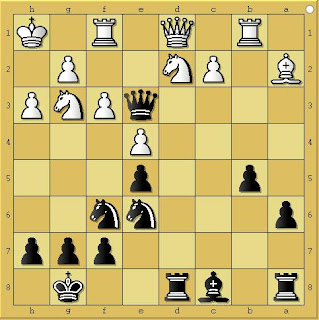
In the previous post we got a rookending and we defined the goals both sides should try to reach. Continuing the pursuit of the goals was rather straightforward and white had to give up his rook to prevent promotion of the kingside passer. But then I encountered the following position: diagram 1 Black to move. Here you have to be very carefull, the minutest slip means a draw here. First we have to redefine the goals of both sides. The goal for white is pretty obvious: The pawn must promote and the white king must keep the road to promotion clear. White needs at least 7 moves for that. Black must conquer the pawn. The most logical place is to intercept the pawn is at g8, which is allready under attack by the rook. This means that the rook is already standing well, this means that the black king must head for h7 or f7. h7 can be reached in 8 moves while f7 can be reached in 5 moves. The following moves the main goals continue to be the same for both sides, but tactically e...

The hidden patterns of logic

Image
In the previous post I mentioned certain ommisions in my pattern database, mainly in the endgame. My main goal is to learn to apply logic to the chessgame, I might as well combine this with endgames. Mr. Z gave me a quite interesting position: . . . . Black to move. This is a win for black, but it is easy to go astray when you play this out against a chess engine. Can we find the moves by applying logic? What is going on in the position? If you think away the rooks, the remaining pawn endgame is an easy win for black. Black has a pawn more at the kingside, which he has to transform into a passer. When white takes the passer with his king, black can eat away the white pawns on the queenside. So white has to avoid the exchange of rooks. This limits the freedom of move of the white rook a bit. The natural targets are the bases of the pawn chains, i.e. h7, b7, a7 and g2, c3, a3. The natural attackers are the rooks. The kings have to prevent the invasion of ...

Applying logic

Image
At Whitsuntide we played a tournament of 7 long otb games. I used the games to check my latest findings. It greatly reflects that my theoretical findings are confirmed in practical play. I scored 4 out of 7 with no draws. TPR was 1754. Winning by mistake. All games had in common that the only way to win them is when the opponent plays a suboptimal move. This means you cannot win a game by finding a move where your opponent has no answer to, but you have to play optimal moves yourself all along until your opponent makes a mistake. Be it a tactical or positional mistake. Your opponent has to defy logic in one way or another. Three areas of improvement. I found three areas to improve my chess in my games. Learning unknown territory. Replacing unfruitful opening lines. Applying logic. These three areas are not equal. The first two can be fixed relatively simple. Applying logic contains the real meat of the matter and has not an easy fix. Learning unknown territory. There are...

A few answers to Bright Knight

Image
BK said: It is not at all clear that it is easier to improve by a fixed percentage on harder problems than it is on easier ones. Back in the days of the Bain Experiment, I found that reducing my solution times by a fixed percentage for my first pass through the first batch of problems gave a good fit to my solution times on the first passes through the later batches of problems. That appears to be roughly right for Woolum too. I advocate to train every specific task that you have to perform in a specialized way. Optimized for that specific task. Preventing diminishing returns. The first thing to do is to determine which tasks we are talking about. Every tasks has its own specialized sets of patterns associated with it, and if you don't find out which patterns to learn, chances are high that you don't learn these patterns at all. First task: 20 tactical elements. The first task we have identified is that we have 20 - 30 elementary tactical themes, depending on t...

Chasing the King

Image
. . . . In order to enhance the speed of solving tactical problems as much as possible, I work with high rated (2300 - 2400 std rating) problems. These often take me half an hour to an hour to solve. If I can speed that up to under 3 minutes, I'm 10-20 x faster. With easy problems it is much more difficult to speed up the same percentage. 3 minutes is the average time you have per move in a long OTB game. Another advantage is that when you need an hour to solve a problem, you can use a stopwatch and a logbook to write down what it is what you are actually doing and what exact costs so much time. My search algorithm is actually developed for duplo attacks and not for traps. And it shows. Whenever I have to chase the king, I'm starting to consume time and to make errors. (I consider a mate to be a special instance of a trap.) This means I will have to work out a separate search algorithm for chasing the king. I will make a set of high rated mates with >4 ...

Tactics flow from a positionally superior game

In my quest to define an intelligent search algorithm for positional chess I had to swallow another disappointment. I bought the book Chess Blueprints: Planning in the Middlegame of Nikolay Yakovlev. I intended to make flashcards of the 188 blueprints he provided. Until I discovered that the author didn't computercheck his book. What's the use of learning the blueprint of a positionally won game when in reality you are loosing the exchange in that particular position. I didn't expect that anno 2010 (the date of publishing). So once again I will have to think for myself. Let's see if we can find a natural hierarchy for chess moves. What do you think about this: Tactics. Targets. Invasion points. Open lines. Space. Tactics. In the end, you will win a game by executing a tactic. If there is a tactical combination around, it usually has the highest priority. Fisher said: Tactics flow from a positionally superior game . How does that work? How does one...

New ATH FIDE estimated

Image
. . . . . . . Since my new approach to study tactics my FIDE estimated ATH increased from 1798 to 1844. The graph above gives you a clue how to interpret these figures. 46 points in one week, not too shabby! My new approach doesn't cover long king chases very well.  I'm very bad at it either. Maybe I must find an apart search algorithm for that.

Chessbase PGN viewer