Posts

Some calculations

 I have been able to reformulate my method of how to study openings in a way that it matches the exact way that I study tactics. This means that I can calculate how much work must be done to acquire a decent basis. A problem costs me 3 minutes at average To absorb a problem I need 20 repetitions at average There are 350 problems based on frequently occuring mates There are 350 problems based on frequently occurring tactics For my special weakness of knight moves, I use another set of 300 problems Each opening has 70 essential variations at average A variation equals a problem in how I approach it and requires the same time to absorb (60 minutes) I have 4 new openings 3x20=60 minutes to absorb a problem or variation. 350+350+300+4x70=1280 problems or variations to absorb. This totals to 1280 hours. With a study time of 3 hours per day, we are talking about 427 days. What do I expect after those 427 days? a decent level of mating skill a decent level of tactics a decent level of knig...

Testing the plan

 I intend to play a tournament at the end of the year. I hope that that will show some rating improvement. I have an ambitious training plan which I am grinding through on a daily basis. There is not much to say about that. I don't want to bore you with it, so I write less about it. For me it are very exciting times, though. Currently I'm testing the plan, in order to see whether some adjustments must be made. The plan to learn five new openings turns out to be over ambitious. So I decided to drop the London system. Besides that, I'm looking to ways to make the QID to have some overlap with the Colle, so I can borrow the ideas from white. The method of rote memorization of opening lines is not good enough. If you have a good memory, it is the lazy approach to obtain some knowledge with minimum effort.  But I started to look a bit like my cat. She wants to be in the house where I am. Since she is faster than me, she tries to predict my moves. It turns out that she is wrong a...

Logical mini tasks

Image
 The past months have convinced me that I learn the right things in the right way. Which is: Tactics, for the moment focussing on mates 4 movers of the most frequent mates (after finishing the 3 movers) Focussing on the chess logic I certainly make progress, but I'm not convinced that I use the most efficient way to absorb the knowledge, though. If you look at the progress of chess prodigies when they were 1700 rated, then an advance of 100 points per year is quite normal. That is not the rate at which I'm advancing yet. Of course, chess prodigies have their coaches, which help them to figure out to overcome their shortcomings. I must figure out everything myself. What are my shortcomings, what is the best training material, which openings to play, how to absorb relevant endgame knowledge et cetera. I will fill the gabs in due time. But back to tactics, Black to move 4rk2/Q3b3/1B4p1/1N1B3p/2P4P/P5rq/5K2/5R2 b - - 1 1  [ solution ] The first move is only clear when you see the...

Educating system 2

Image
 System 1 educates itself by looking over the shoulder of system 2. This implies that the only thing that we have to worry about is to educate system 2 well. If system 2 occupies itself with useful chess logic with a high frequency of occurrence, both systems will thrive. How does that look like? Black to move 8/5N2/6P1/3p4/B7/3nPkP1/1r6/6K1 b - - 0 1 [ solution ] The first thing is that you have to see what the position is about. You need to have the checkmate patterns under your belt. Only when you SEE the salient cue "Arabian mate", you can build some logic around it. 3 movers are fit to learn the patterns. But after you master those, 4 movers are very good to build your chess logic.  Without the salient clue "Arabian mate", you will have to resort to trial and error. Which probably will fail which these 4 movers. The Arabian mate is usually in the corner of the board. But the walls of the killbox can be anything. As long as the enemy king cannot pass the walls. ...

More about logic

Image
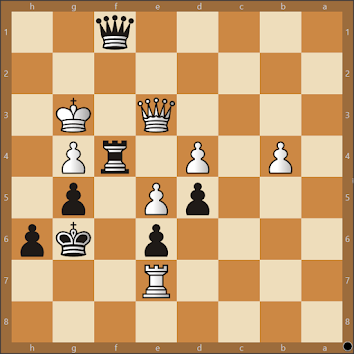
 What's the role of logic? In order to educate the vulture, it must look over the shoulder of system 2. That only can be propitious when system 2 does something useful. The PoPLoAFun system is helpful for a logical approach to a problem by system 2. How does that work? Diagram 1. Black to play 4r1k1/pp3p1p/5Qp1/5n2/3B4/3R1K1P/P2R1P2/2q5 b - - 0 1  [ solution ] The king is in a potential killbox. As long as you are not in check AND you are able to give checks yourself, you can ignore your opponents static pieces. Only the dynamic pieces that can interfere with the lines of attack need to be considered. But I bet you aren't able to ignore the mate in 1 from white 😉 The first thing is to prevent the escape from the white king to g2. So you look for a check that covers g2 at the same time. There are two moves. 1.. ... Qc6+ and 1. ... Qh1+ White can have an influence on the former by 2.Qxc6, so let's consider the latter. 1. ... Qh1+ 2.Kf4 leads to a simple mate in two with 2...

What we know so far

Image
 The past 18 years quite a few facts have presented themselves. All facts need to be met by any theory about chess improvement. What do we know? Papa Polgar proved that talent is not needed when the right education is provided Ton Sijbrands was a champion in checkers, but a mediocre chess player. So it is not a brain thing. He learned chess at a much later age than checkers. So a brain change by aging might be involved. When you learn a Spanish word, you are inclined to forget the same word in German. So the age thing might be a replacement thing of a full brain. From Troyis we learned that you can learn to manipulate knight moves in the brain in a grandmasterly manner. When you plateau in Troyis you can go in two different directions: exercise to make your current skills better or develop a new strategy and make that a new skill. Susan Polgar's simul exhibition showed that it is a skill trick. There is no thinking involved. Mr. Z learned us that visualization must be guided by a l...

Getting persnickety

  How do chess prodigies get their teachings when super grandmasters are not able to coach them? I stumbled upon this  serendipity and made this half serious and half with tongue in cheek statement. But the ensuing comments showed that I might try to develop a hypothesis from this. Basic tactics. Tactics with a name (black and white) Advanced tactics. Tactics with no name (50 shades of grey) Basic positional play. Manoeuvres with a name   (black and white) Advanced manoeuvres. Manoeuvres with no name (50 shades of grey) Basic knowledge. Knowledge with a name    (black and white) Advanced knowledge. Knowledge with no name (50 shades of grey) The first four points, I reckon to be skill. The last two are knowledge, evidently. I master points 1, 3 and 5 to a certain degree. And I assume that that applies to most adult plateauing club players. I have some black and white skills, and some black and white knowledge. I reckon that from candidate masters and hi...

Chessbase PGN viewer